WORLDWIDE FREE SHIPPING
Fictional Nature Field Journal — The Sleeping Threshold, Japan
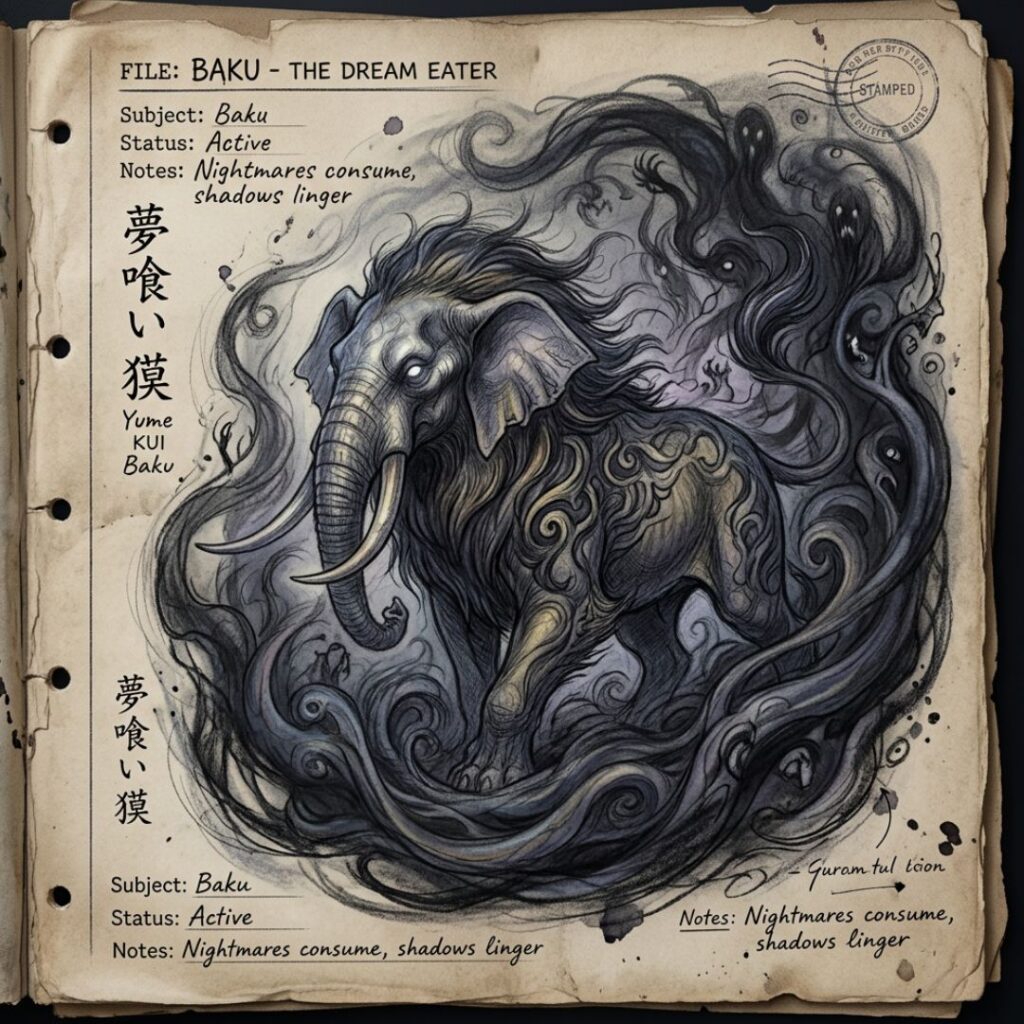
“If a dream has teeth, do not name the teeth. Call the thing that eats them. Say Baku before the dawn finds you still afraid.“ — Attributed to a Kyoto household instruction, late Edo period oral tradition.
Classification Status: Active Oneiric Entity — Category II (Protective Dream Predator with Household Invocation Complex).
Region of Presence: Japan, with older antecedent forms in Chinese mo traditions and strong early modern Japanese visual evidence in Edo-period carvings, talismans, printed images, and household belief.
Habitat Range: Human sleep, bedside spaces, children’s rooms, pillows, temple and shrine-adjacent protective imagery, and the liminal interval between nightmare and waking.
Japanese Designation: Baku — a supernatural dream-eating beast, now linguistically connected in modern Japanese with the tapir, but historically much older and stranger than the animal alone.
Primary Function: Devours nightmares when summoned, especially by sleepers who wake before dawn from a dream carrying fear into the room.
Traditional Warning: Do not summon unnecessarily. A hungry Baku may continue eating after the nightmare is gone — consuming ordinary dreams, hopes, desires, and the inner pressure that makes a life move forward.
Known Morphology: Elephant trunk, tusks, tiger claws, ox tail, heavy body, and a composite form resembling a creature built from several powerful animals at once.
The first mistake is to call Baku a monster.
Japan has no shortage of things that wait in rivers, trees, abandoned houses, graveyards, mountain passes, and roadside shadows. Many of them are dangerous. Some are hungry. Some are not evil in the human sense but operate according to laws that humans are not built to survive. Baku belongs beside them only partially. It has the body of a beast, the appetite of a predator, and the atmosphere of something older than comfort. But in the tradition, it does not hunt the sleeping person.
It hunts what hunts the sleeping person.
That distinction is the entire animal. Baku is not the nightmare. Baku is the thing called after the nightmare has entered the room and left its marks on the body: sweat, clenched fingers, breath caught in the throat, a child sitting upright and unable to explain why the darkness now feels occupied. The old instruction is practical. Wake from a bad dream. Call Baku. Ask it to eat what followed you back.
The dream is not analysed. It is not interpreted. It is not written down and turned into prophecy. It is removed.
This makes Baku one of the most ecologically precise creatures in Japanese folklore. It fills a niche that every human culture eventually identifies: the disposal of psychic carrion. Human beings dream because the mind continues working after the body has gone still. Sometimes that work produces visions that restore, warn, prepare, or console. Sometimes it produces something rotten. Baku exists because not everything produced by the sleeping mind should be allowed to remain until morning.
Part I: The Named Dream
Before Baku can be understood, the dream must be treated as a place.
Not a metaphorical place. Not merely a psychological event. A place in the old sense: a territory with thresholds, visitors, dangers, rules of entry, and things that should not be brought back across the border. Many Japanese supernatural traditions are built around crossings. Mountains, bridges, rivers, dusk roads, temple gates, house thresholds, the hour between night and morning — all of these are places where ordinary boundaries weaken. Sleep is one of the oldest thresholds humans enter every night and pretend, for practical reasons, not to fear.
Baku lives at that threshold.
The creature’s older background reaches into Chinese traditions surrounding the mo, a strange beast described across centuries as powerful, composite, and protective. When the idea moved through Japanese literary, artistic, and religious imagination, it specialized. What had been a wonder-beast associated with protection against evil and illness became, in Japanese tradition, the eater of bad dreams. The function narrowed, but it did not weaken. It became sharper. The creature no longer guarded against every misfortune. It guarded the pillow.
This narrowing tells us something important about how folklore behaves. A mythic animal survives when it finds work. In Japan, Baku found work in the most vulnerable room of the house. A child wakes from a nightmare, and the household does not need a theological debate. It needs a procedure. The name is the procedure. The name is small enough for a frightened mouth to say in the dark.
Baku-san, come eat my dream.
Three times, in many tellings. Once to name the predator. Once to point it toward the prey. Once to close the passage behind it.
“My mother told me not to call Baku for every bad sleep. Only for the dreams that still had their hands on me after I woke.“ — Attributed to Emi Sagawa, family recollection, Nara Prefecture, collected account, 1998.
◈ DOSSIER FILE: BAKU
The Dream Eater — Guardian of the Pillow Threshold
[Darkmyths Classification: Category II — Protective Oneiric Predator with Active Household Invocation Practice]
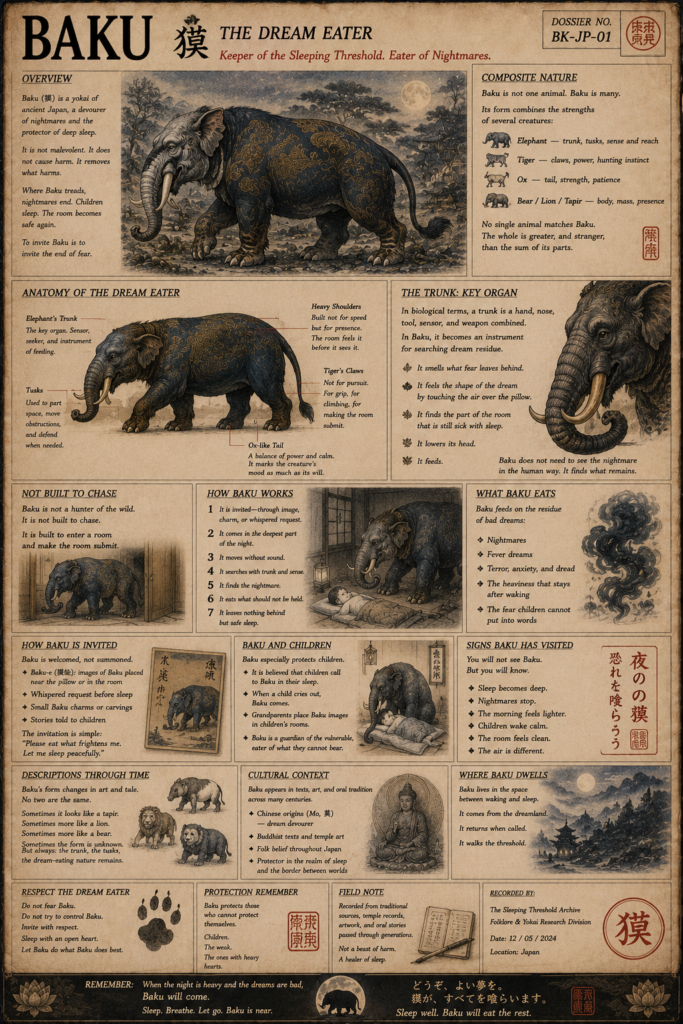
PHYSICAL PROFILE
Baku is a composite animal. This is the first and most important detail. The modern mind wants to simplify it into a tapir because modern Japanese uses the same word, baku, for the Malayan tapir. That resemblance is useful, but it is not enough. The older creature is stranger. It carries an elephant’s trunk and tusks, tiger’s claws, an ox-like tail, a heavy body that shifts between bear, lion, and tapir depending on the image, and a posture that suggests not speed but weight.
It is not built to chase. It is built to enter a room and make the room submit.
The trunk is the key organ. In biological terms, a trunk is a hand, nose, tool, sensor, and weapon combined. In Baku, it becomes an instrument for searching dream residue. The creature does not need to see the nightmare in the human way. It smells what fear leaves behind. It feels the shape of the dream by touching the air over the pillow. It finds the part of the room that is still sick with sleep, lowers its head, and feeds.
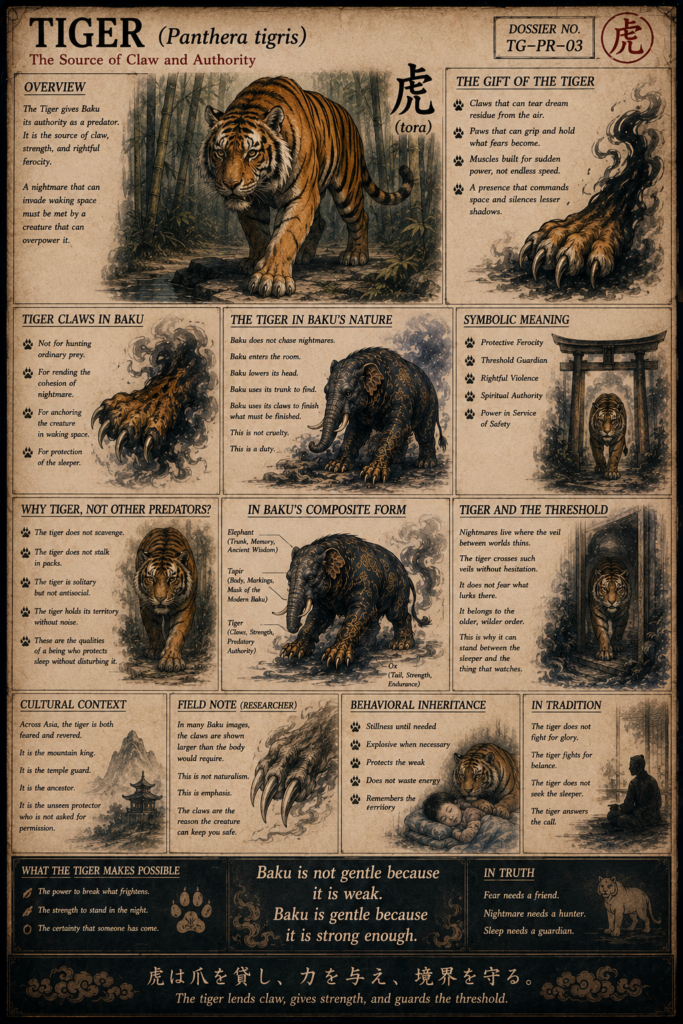
The tiger claws are not decoration. They identify Baku as a predator. However gentle the bedtime version becomes, the older form retains killing instruments. This matters because the nightmare is treated as prey, not as a symbol. Baku does not comfort the nightmare into leaving. It does not negotiate. It consumes.
The ox tail and heavy body ground the creature in material strength. A nightmare is weightless to the waking eye, but anyone who has woken from one knows this is false. Nightmares have mass. They sit on the chest. They drag the mind backward into images it does not want. A light creature could not remove them. Baku is heavy because the thing it eats is heavy.
In Edo-period carvings and netsuke, Baku appears as something small enough to be held, worn, or placed close to the body. That does not reduce its power. Japanese protective objects often work through compression: the large force made portable, the god reduced to an amulet, the dangerous animal contained in a carved form so it can stand guard without devouring the household by accident. A Baku carving beside the bed is not a toy. It is a stationed predator.
THE DIFFERENT PHASES
Darkmyths identifies two behavioural states in the Baku tradition: the Sleeping Phase and the Feeding Phase.
The Sleeping Phase is not sleep in the human sense. It is dormancy. Baku remains near the threshold of dreams, present but inactive, like an animal lying beyond the firelight. It does not enter every dream. It does not prevent all fear. Its restraint is part of its function. A creature that ate every difficult dream would damage the human mind. Some dreams are warnings. Some are grief doing its necessary work. Some are memory cleaning its own wounds. Baku waits for the dreams that have become invasive.
The Feeding Phase begins when the sleeper wakes and calls, or when the nightmare becomes strong enough to leave residue in the waking room. Traditional accounts describe the invocation simply: the frightened person calls Baku and asks it to eat the dream. The creature arrives, consumes the bad dream, and allows sleep to return. In many tellings, the sleeper does not remember the nightmare clearly afterward. Only the fact of having been afraid remains.
This forgetting is not incidental. It is evidence of complete feeding. A half-eaten nightmare returns. A fully eaten nightmare leaves behind only the knowledge that something had been there.
THE WARNING ATTRIBUTE
The most important thing about Baku is not that it helps. The most important thing is that the tradition warns against overusing it.
A lesser folklore would make the creature purely benevolent. It would appear, eat the nightmare, and vanish without consequence. Japanese tradition is more precise than that. Baku is helpful because it is hungry. Hunger is not morality. Hunger is direction. When the nightmare is present, the direction is useful. When the nightmare is gone, the appetite remains.
Some versions warn that if Baku is summoned unnecessarily, or if it remains hungry after consuming the bad dream, it may continue feeding on other contents of the sleeper’s inner life. First the nightmare disappears. Then the ordinary dream. Then desire. Then ambition. Then the capacity to imagine a future with enough force to pursue it. The person becomes calm, but not healed. Empty, but not peaceful.
This is extraordinarily sophisticated dream theology. The tradition does not say all fear should be destroyed. It says corrupted fear should be eaten. A nightmare that clings to the waking body is pollution. A troubling dream that teaches caution may be necessary. Baku is not called to remove the difficult parts of being alive. It is called when the dream has become a parasite.
STATUS: Category II. Protective but dangerous. Beneficial when properly summoned. Potentially hollowing when used carelessly. The creature does not distinguish comfort from emptiness unless the caller does.
Part II: What Enters the Dream
Baku’s origin cannot be reduced to one country, one text, or one animal. The creature is a transmission object. It passed through Chinese, Buddhist, literary, artistic, and household channels before becoming the Japanese dream-eater most people recognize today.
The Chinese mo tradition supplied the older body: a strange, powerful beast with mixed animal features and protective qualities. In some accounts, its image repelled evil or sickness. This already placed the creature in an apotropaic category — not merely a beast to be feared, but a beast whose image could push danger away. When that creature entered Japanese imagination, the danger became more specific. Illness, evil, and misfortune narrowed into nightmare.
This movement from general protection to dream protection may seem like a reduction, but it is actually a specialization. A general guardian stands at the gate. Baku stands at the pillow. A general guardian keeps enemies away from the house. Baku removes the enemy that has already crossed into the sleeper’s mind. Its work is intimate in a way that most protective spirits are not.
By the Edo period, Baku was firmly visible in Japanese art. Carvings, netsuke, and images show the creature not as a vague idea but as a recognized supernatural animal. The eighteenth-century Japanese wood object catalogued by LACMA as Baku: Monster that Eats Nightmares preserves this exact understanding: a small carved body carrying the full burden of a large invisible function.
The scale matters. A nightmare is enormous while it is happening. It can cover a world. Yet the thing used against it may be small: a carved figure, a word, a whispered name, a picture tucked near a pillow. Japanese ritual technology often works this way. The object is not large because the object is not the power. The object is the address.
“A charm is not a wall. It is a door with a name written on it. The correct thing knows where to enter.“ — Attributed to a temple attendant, Kyoto, collected account, 1912.
◈ DOSSIER FILE: THE DREAM WORLD
The Territory Baku Hunts
[Darkmyths Oneiric Profile — the sleeping ecology where nightmares become prey]
THE NIGHTMARE (Oneiric parasite / fear-form)
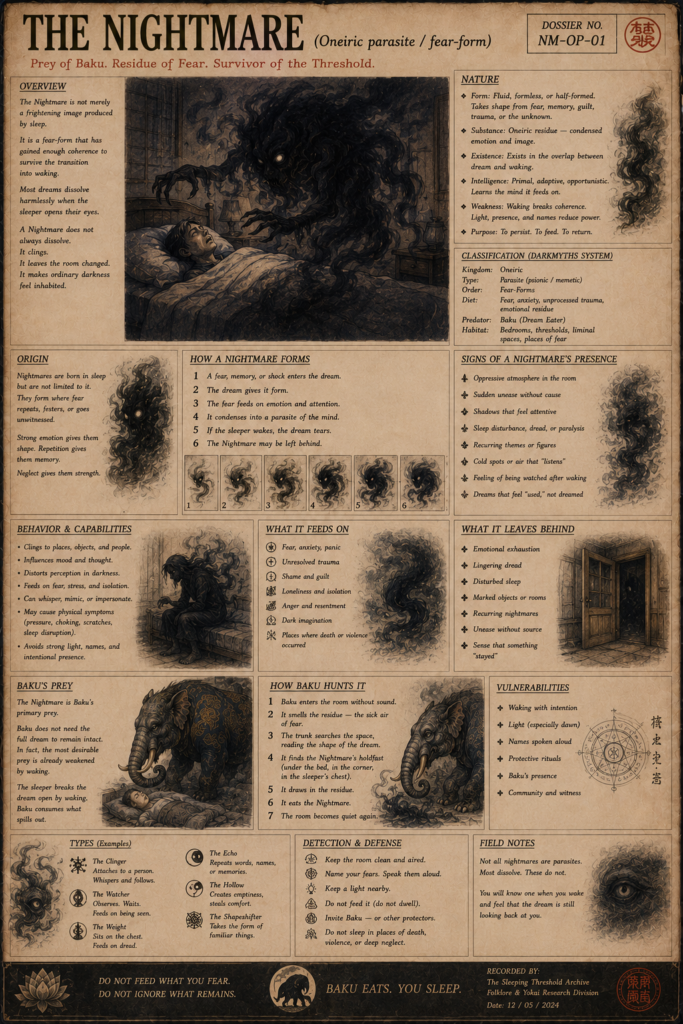
The nightmare is Baku’s primary prey. In the Darkmyths classification system, it is not merely a frightening image produced by sleep. It is a fear-form that has gained enough coherence to survive the transition into waking. Most dreams dissolve harmlessly when the sleeper opens their eyes. A nightmare does not always dissolve. It clings. It leaves the room changed. It makes ordinary darkness feel inhabited.
Baku feeds on this residue. It does not need the full dream to remain intact. In fact, the most desirable prey is already weakened by waking. The sleeper breaks the dream open by waking. Baku consumes what spills out.
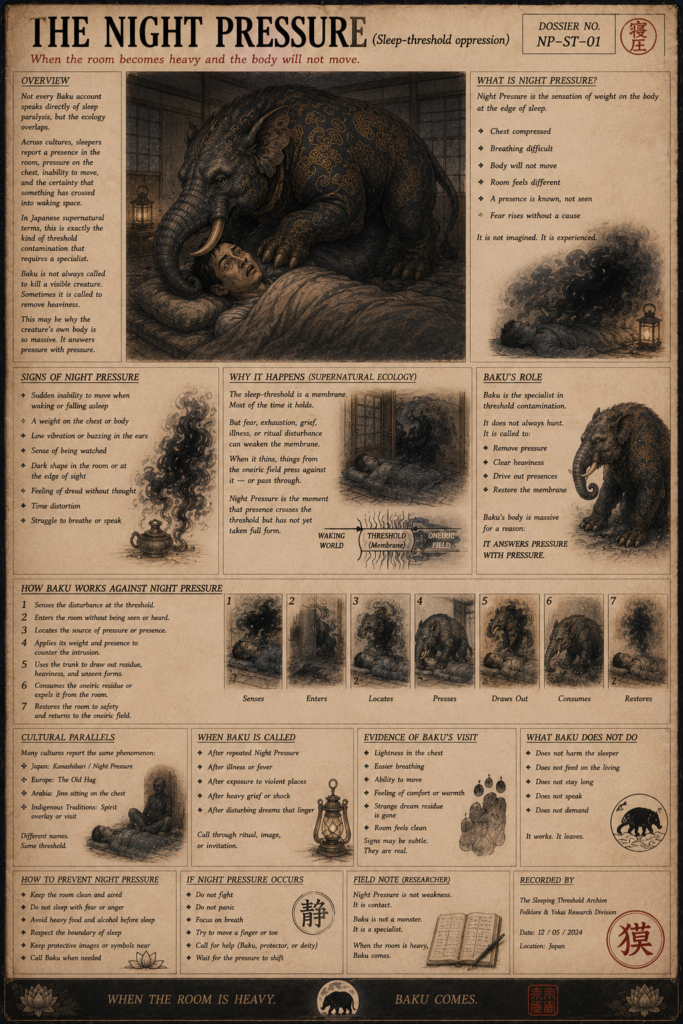
THE NIGHT PRESSURE (Sleep-threshold oppression)
Not every Baku account speaks directly of sleep paralysis, but the ecology overlaps. Across cultures, sleepers report a presence in the room, pressure on the chest, inability to move, and the certainty that something has crossed into waking space. In Japanese supernatural terms, this is exactly the kind of threshold contamination that requires a specialist.
Baku is not always called to kill a visible creature. Sometimes it is called to remove heaviness. This may be why the creature’s own body is so massive. It answers pressure with pressure.
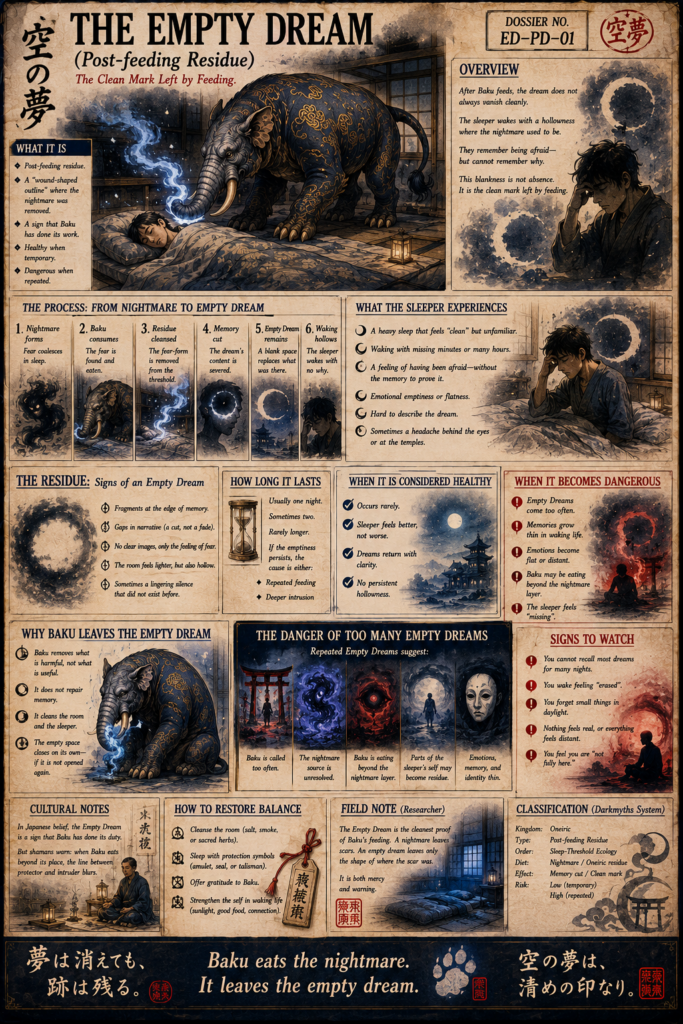
THE EMPTY DREAM (Post-feeding residue)
After Baku feeds, the dream does not always vanish cleanly. Sometimes the sleeper remembers being afraid but cannot remember why. This blankness is not absence in the ordinary sense. It is the clean mark left by feeding. The nightmare has been removed so completely that only the wound-shaped outline remains.
This condition is considered healthy when temporary. It becomes dangerous when repeated. Too many empty dreams suggest Baku is being called too often, or that the creature has begun eating beyond the nightmare layer.
Part III: The Animals Inside the Dream Eater
Baku is not one animal. It is an animal argument.
Every part of its body contributes a function. The elephant trunk searches. The tiger claws hold and tear. The ox tail grounds the creature in farmyard mass and domestic familiarity. The bear-like body gives it endurance. Later, the tapir provides a softer modern silhouette, allowing the creature to survive in children’s books, animation, toys, and mascots without losing its core identity.
This is how old monsters survive modernity. They accept a new body while keeping the old appetite.
The Malayan tapir is especially important because it explains the modern confusion. The tapir’s flexible snout and black-and-white body create a natural visual bridge to the older Baku. But the tapir does not explain the whole creature. It cannot account for the tiger claws, the ox tail, or the function of nightmare consumption. The tapir is the mask Baku wears now. The older animal is still underneath.
The elephant remains more central than many modern readers realize. A trunk is the perfect organ for a dream predator. It reaches without exposing the whole body. It tests the air. It pulls hidden things from narrow places. In a sleeping room, where the danger is invisible, the trunk makes mythological sense. Baku needs a face that can search what cannot be seen.
◈ DOSSIER FILE: FAUNA OF THE BAKU BODY
The Real Animals Hidden in the Dream Eater
[Darkmyths Fauna Profile — biological fragments that explain the creature’s mythological anatomy]
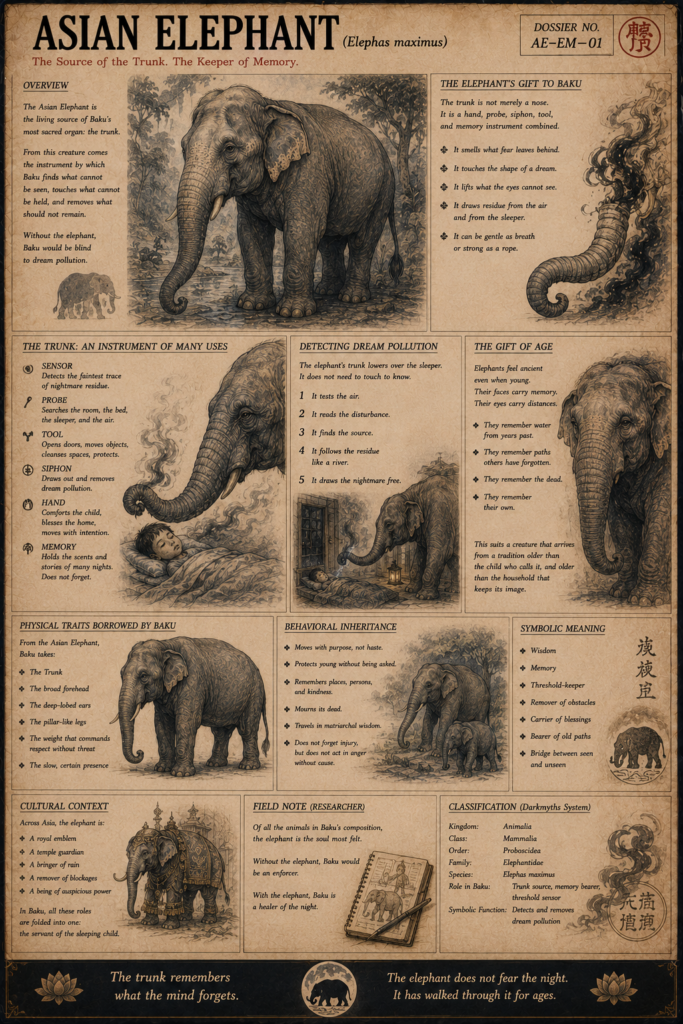
ASIAN ELEPHANT (Elephas maximus)
The elephant gives Baku its most important sensory organ. A trunk is not merely a nose. It is a hand, probe, siphon, tool, and memory instrument. In the Baku tradition, the trunk becomes the organ that detects dream pollution. It lowers over the sleeping face, searches the room, finds the nightmare’s remaining scent, and pulls it free.
The elephant also contributes age. Elephants feel ancient even when young. Their faces carry memory. This suits a creature that arrives from a tradition older than the child who calls it and older than the household that keeps its image.
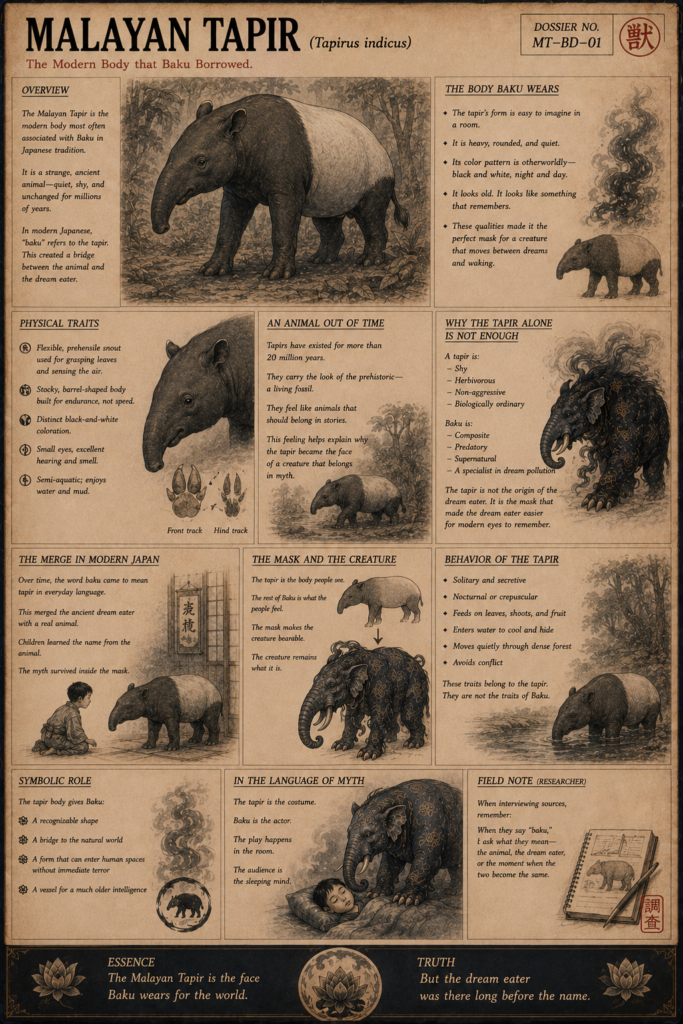
MALAYAN TAPIR (Tapirus indicus)
The tapir is the modern body Baku borrowed. It has a flexible snout, a strange black-and-white body, and the soft, prehistoric look of an animal that seems to have walked out of a dream without asking permission. Modern Japanese uses baku for the tapir, which has encouraged the two images to merge.
But the tapir alone cannot explain the myth. A tapir is shy, herbivorous, and biologically ordinary. Baku is composite, predatory, and supernatural. The tapir is not the origin of the dream eater. It is the mask that made the dream eater easier for modern eyes to remember.
TIGER (Panthera tigris)
The tiger gives Baku its authority as a predator. The dream eater is not merely a soft guardian. Older descriptions preserve claws because the creature must be capable of overpowering what humans cannot. A nightmare powerful enough to wake the body needs more than sympathy. It needs a stronger animal.
Tiger paws also place Baku in a larger Asian symbolic field of protective ferocity. The same quality that makes the tiger dangerous makes it useful at a threshold. It is not safe because it is gentle. It is safe because it is on the correct side of the door.
Part IV: How to Call What Eats the Dream
Baku is summoned by need, not curiosity.
The traditional formula is simple enough for a child to use: call Baku and ask it to eat the dream. In many versions, the name is repeated three times. Repetition matters in household magic. One utterance may be panic. Two may be uncertainty. Three becomes structure. It makes a path for the creature to follow.
The timing is equally important. Baku is usually called after waking from a nightmare, particularly before dawn. This is the vulnerable interval when the dream has not fully dissolved and the waking world has not fully reasserted itself. The door is still open. The thing that followed the sleeper back has not yet hidden. Baku can still smell it.
Images of Baku also function as pre-emptive invitations. A carving, talisman, or printed image near the bed tells the creature where work may be required. It is the difference between calling a guard after the intruder has arrived and stationing the guard outside the room before nightfall. Both practices belong to the same logic. The sleeper is not helpless. The household has procedures.
But the warning remains. Baku must not become a substitute for dreaming. To ask it to remove a nightmare is reasonable. To ask it to remove all troubling sleep is spiritually dangerous. Dreams do not exist only to comfort the dreamer. Some contain grief. Some contain warning. Some contain memory trying to return with enough force to be acknowledged. If Baku eats these too often, the sleeper may become peaceful in the way an empty house is peaceful.
“You call Baku for the dream that bites. Not for the dream that speaks.“ — Attributed to an Osaka grandmother’s saying, collected account, 1976.
THE MODERN SURVIVAL
Baku survived because every generation still has nightmares.
Many supernatural creatures weaken when their original landscape changes. River monsters suffer when rivers are channelled. Mountain beings retreat when roads cut through forests. House spirits vanish when houses no longer have the architectural features that supported them. Baku has no such problem. Its territory is not a bay, forest, cave, or field. Its territory is sleep. As long as human beings dream badly, Baku has prey.
Modern culture has softened its shape. The old elephant-tiger-ox chimera often appears now as something closer to a tapir: rounder, quieter, less dangerous to look at. This is not necessarily a betrayal. Folklore changes its face to remain speakable. A child may not want the older beast beside the bed. The tapir-faced Baku is easier to invite. But beneath the gentler outline, the same transaction remains. Something frightening enters the dream. Something hungrier is called to remove it.
The older warning also survives because it is psychologically true. A life without nightmares may be a blessing. A life without dreams is not. The tradition understood this long before modern language gave us terms for repression, emotional numbing, trauma residue, or the mind’s need to process fear through images. Baku is not a cure for the unconscious. It is an emergency scavenger.
This is why the creature remains one of Japan’s most elegant supernatural inventions. It does not deny fear. It gives fear an ecological predator. It does not promise that the night is empty. It promises that the night has rules, and that not everything living there is against you.
FINAL FIELD ASSESSMENT
Baku should not be classified as a demon, ghost, or ordinary yokai predator. It is better understood as a protective scavenger of the dream world — a creature whose terrifying qualities are precisely what make it safe to summon under correct conditions. It is strong enough to eat what humans cannot bear to carry. That strength is useful. It is also dangerous.
Its composite body preserves the memory of older Chinese protective beasts, Japanese artistic transformation, household ritual, and the modern tapir-shaped image that keeps the creature alive in popular culture. Its function remains consistent through every change of form. Baku eats nightmares. Baku must be respected. Baku must not be called for every darkness.
The correct relationship is not worship. It is not friendship. It is not ownership. It is preparation.
Keep the image near the bed. Teach the name carefully. Use it only when the dream has followed you too far.
Because the nightmare is not always the most dangerous thing in the room.
Sometimes the most dangerous thing is the hunger that saves you from it.
STATUS: Category II. Active cultural entity. Protective dream predator. The images remain. The name remains. The nightmares continue. And in Japanese folklore, somewhere just outside the waking room, Baku waits for the sleeper to call.