WORLDWIDE FREE SHIPPING

Fictional Nature Field Journal — Rice Fields, Shrine Roads, and Foxfire Country, Japan
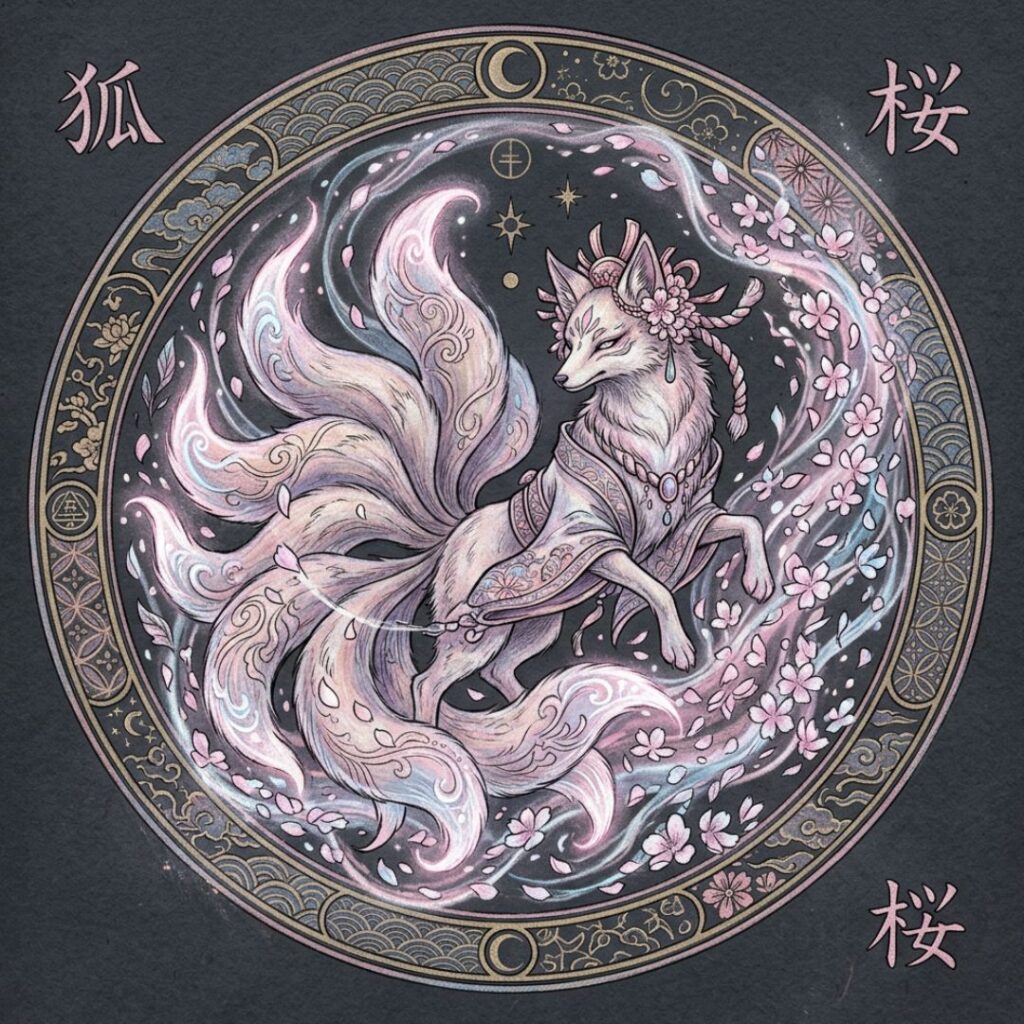
“When the fox crosses the field road at dusk, do not decide too quickly whether you have seen an animal, a messenger, a woman, a flame, or a warning. The fox has already decided what you are allowed to see.“ — Traditional field saying associated with Inari shrine roads and rural fox lore.
Classification Status: Active Yokai-Kami Interface Entity — Category I/III Variable (Sacred Messenger, Trickster, Possessor, Wife-Spirit, and Nine-Tailed Transformative Being).
Region of Presence: Japan broadly, with strong concentrations in rice-growing landscapes, Inari shrine networks, mountain villages, old roads, forest margins, Edo-period urban folklore, and foxfire regions such as Ōji in Tokyo and other localities associated with kitsunebi.
Habitat Range: Rice fields, shrine precincts, household thresholds, mountain paths, abandoned houses, roadside trees, dusk roads, dreams, possession states, and areas where weather, light, marriage, hunger, and illusion overlap.
Japanese Designation: Kitsune — fox; fox spirit; supernatural fox; shapeshifting fox yokai; messenger of Inari Ōkami when operating in sacred form.
Primary Functions: Divine messenger, field guardian, trickster, seducer, wife, illusionist, possessor, omen-bearer, fire-bearer, and spiritual intelligence capable of crossing between animal, human, and kami-adjacent states.
Power Development: Kitsune grow in power with age. Folklore often links older foxes with additional tails, culminating in the nine-tailed fox — a being of exceptional age, intelligence, magical ability, and danger.
Known Manifestations: White fox messenger, red field fox, beautiful woman, old man, bride, wandering light, flame procession, possessing spirit, fox wife, pipe fox, celestial fox, and nine-tailed golden fox.
The kitsune is not one creature.
This is the first thing every field observer gets wrong. They arrive looking for the Japanese fox spirit, as if the fox has one behaviour, one moral alignment, one body, one story. It does not. The kitsune is a species of boundary. It is animal and not animal, messenger and deceiver, wife and predator, sacred servant and household curse. It belongs to Inari shrines and mountain roads, to harvest prayers and possession panics, to romantic folktales and the terrifying legend of the nine-tailed fox.
A fox seen beside a rice field may be only a fox. A fox seen at the edge of a shrine path may be an attendant of Inari. A fox seen as a woman on a rainy road may be a bride, a trap, a blessing, or the beginning of a family line no one will be able to explain later. A fox seen as a line of blue-white fire on New Year’s Eve may not be a fox at all, but a procession of foxes wearing light instead of bodies.
The question is never simply, “Is the kitsune good or evil?”
The correct question is: which fox, under whose authority, at what age, in which landscape, and what does it want?
Part I: The Fox at the Edge of the Rice Field
Before the kitsune became a seductress, trickster, foxfire, possession spirit, or nine-tailed catastrophe, it was a fox near food.
Rice fields are not merely agricultural spaces in Japanese religious imagination. They are negotiated landscapes. Water must arrive at the correct time. Seedlings must root. Rats must be kept out. Weather must behave. Harvest must succeed. In such a landscape, the red fox is not decorative. It is a predator of rodents, a dusk-walker along the border of cultivation, an animal that appears exactly where the human community is most vulnerable to hunger.
This is one reason foxes became tied to Inari Ōkami, the kami associated with rice, fertility, prosperity, industry, and household success. The sacred white foxes at Inari shrines are not usually Inari themselves. They are messengers, attendants, carriers, eyes, mouths, and sometimes guardians of the deity’s work. They stand in pairs at shrine entrances. They hold keys, scrolls, jewels, or sheaves. They watch the visitor with an expression that is not quite animal and not quite human.
The whiteness matters. A white fox is an omen animal, purified from the ordinary red-brown field body into a sacred sign. The field fox eats rats; the shrine fox carries divine intention. Folklore keeps both truths without needing to collapse them. The kitsune begins as ecology and becomes theology.
That transformation is the centre of the myth. A fox is useful because it hunts what damages the harvest. A fox is uncanny because it appears at twilight, vanishes into grass, screams like a human child, and seems to know more than an animal should. A fox becomes sacred when the community recognizes that the same intelligence that haunts the field may also guard it.
“The fox takes from the field, but it also keeps the field from being taken. This is why the shrine path and the furrow are closer than they look.“ — Traditional interpretation of Inari fox belief.
◈ DOSSIER FILE: KITSUNE
The Fox Spirit — Messenger, Trickster, Wife, Flame, and Nine-Tailed Intelligence
[Darkmyths Classification: Category I/III Variable — Sacred Messenger in Inari Context; Dangerous Transformative Yokai in Wild Context]
PHYSICAL PROFILE
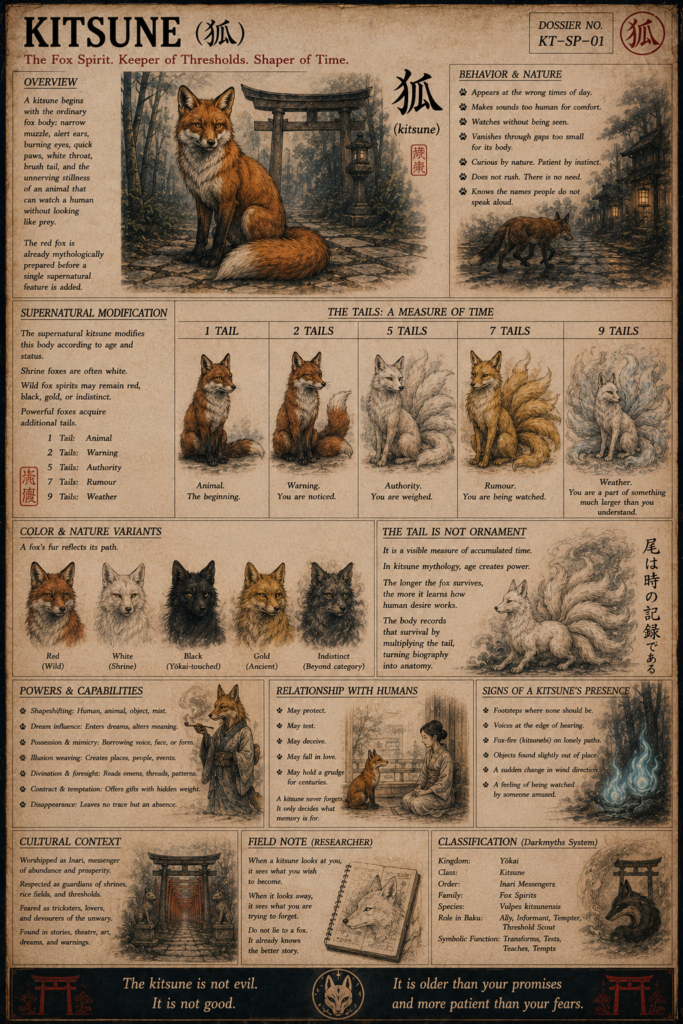
A kitsune begins with the ordinary fox body: narrow muzzle, alert ears, burning eyes, quick paws, white throat, brush tail, and the unnerving stillness of an animal that can watch a human without looking like prey. The red fox is already mythologically prepared before a single supernatural feature is added. It appears at the wrong times of day, makes sounds too human for comfort, and vanishes through gaps that seem too small for its body.
The supernatural kitsune modifies this body according to age and status. Shrine foxes are often white. Wild fox spirits may remain red, black, gold, or indistinct. Powerful foxes acquire additional tails. One tail is animal. Two tails are warning. Five tails are authority. Seven tails are a rumour you should not follow. Nine tails mean the fox has become a weather system of intelligence.
The tail is not merely ornament. It is a visible measure of accumulated time. In kitsune mythology, age creates power. The longer the fox survives, the more it learns how human desire works. The body records that survival by multiplying the tail, turning biography into anatomy.
The kitsune’s most famous ability is transformation. It can appear as a woman, an old man, a young bride, a monk, a traveller, a child, or a person known to the observer. In many tales, transformation improves with age. Younger foxes make mistakes. They forget to hide the tail. Their shadow remains vulpine. Their reflection betrays them. A dog notices. A sleeping husband sees a brush tail slip from beneath the robe. The disguise is perfect only until the animal part of the fox insists on being remembered.
This is why the kitsune is so often linked to romance and marriage. It knows the human form well enough to enter the household, but not always well enough to stay there forever. The fox wife is one of the most powerful Japanese folktale forms because it treats supernatural marriage not as fantasy but as domestic pressure. The human spouse receives love, children, prosperity, and mystery. The fox wife receives shelter and intimacy. The household receives a secret that will eventually become too visible to keep.
THE SHRINE PHASE AND THE WILD PHASE
Darkmyths identifies two primary behavioural states in kitsune traditions: the Shrine Phase and the Wild Phase.
The Shrine Phase is ordered, bright, directional, and contractual. In this state, the kitsune operates as a messenger of Inari. It stands at the shrine gate. It receives offerings. It carries petitions. It guards rice, prosperity, and business. It may hold a key to the granary, a wish-fulfilling jewel, a scroll of divine instruction, or a symbolic sheaf. Its power is dangerous only in the way sacred things are dangerous: not because it is malicious, but because it belongs to an order that requires respect.
The Wild Phase is different. The fox leaves the shrine road. It moves through the field edge, night path, abandoned house, and human appetite. In this state the kitsune tricks, tests, seduces, possesses, rewards, punishes, and deceives. It may appear as a beautiful woman, lead travellers astray, create phantom houses, light ghostly fires, or enter a human body and speak through it. This is not simply evil. It is fox logic unbound from shrine discipline.
The same animal can pass between these states. That is what makes kitsune mythology so unstable. A fox may be a divine messenger in one context and a dangerous deceiver in another. The line is not species. The line is relationship.
THE FOXFIRE ATTRIBUTE
Kitsunebi, foxfire, is one of the clearest signs that the fox has left ordinary animal behaviour behind. It appears as mysterious lights in fields, forests, riverbanks, shrine roads, and distant processions. Sometimes the lights are explained as foxes carrying flames. Sometimes the flame comes from the fox’s breath, tail, or jewel. Sometimes it appears as lanterns from an unseen wedding procession moving across the dark.
Foxfire is not illumination in the ordinary sense. It does not simply reveal the path. It asks whether the path is real. A traveller who follows kitsunebi may find a shrine, a wedding, a bog, an empty field, or nothing at all. The light is therefore both signal and test. It gives direction without guaranteeing destination.
At Ōji, foxfire traditions became tied to New Year’s Eve and the gathering of foxes before visiting Ōji Inari. In some accounts, the number of lights could be counted as an omen for the coming harvest. This returns the fox to the agricultural world: fire in the darkness, foxes gathering, humans watching from a distance and reading the year from lights they do not control.
STATUS: Active luminous manifestation. Often associated with procession, omen, misdirection, fertility, and the border between fox society and human perception.
Part II: The Woman With the Tail
The fox wife story is one of the oldest and most revealing kitsune patterns in Japan. It begins with intimacy and ends with recognition.
A man encounters a woman. She may be beautiful, lost, poor, mysterious, or simply present at a moment when the story needs her to appear. They marry. The household prospers. Children are born. For a time, the boundary between human and fox holds. The wife cooks, speaks, sleeps, loves, and behaves as a woman. Then something happens. A dog barks. A child notices. The husband glimpses a tail. The disguise fails not because the wife stops loving the household, but because the fox body remains true underneath the human form.
In many versions, once discovered, the fox wife must leave. The sorrow of these tales is not that she was false. The sorrow is that she was both. She was wife and fox. Mother and spirit. Domestic and wild. The revelation does not necessarily prove deception in the simple moral sense. It proves that the household had been sheltering more reality than it could continue to contain.
The famous folk etymology of kitsune sometimes plays with this intimacy: “come and sleep” or “always comes.” Whether linguistically accurate or not, the story logic is exact. The fox comes into the bed, into the family, into the human line. It does not remain safely outside the village as an animal omen. It enters marriage.
This is why kitsune mythology is more unsettling than simple monster folklore. A monster can be kept outside. A fox wife has already been invited in.
“The fox wife does not become dangerous when her tail is seen. She becomes impossible to misunderstand.“ — Darkmyths field note on the fox-wife tale type.
◈ DOSSIER FILE: FORMS OF THE KITSUNE
Known Social, Sacred, and Dangerous Manifestations
[Darkmyths Field Profile — classification of fox-spirit behaviour by relationship to humans and kami]
ZENKO (Good fox / Inari-aligned fox)
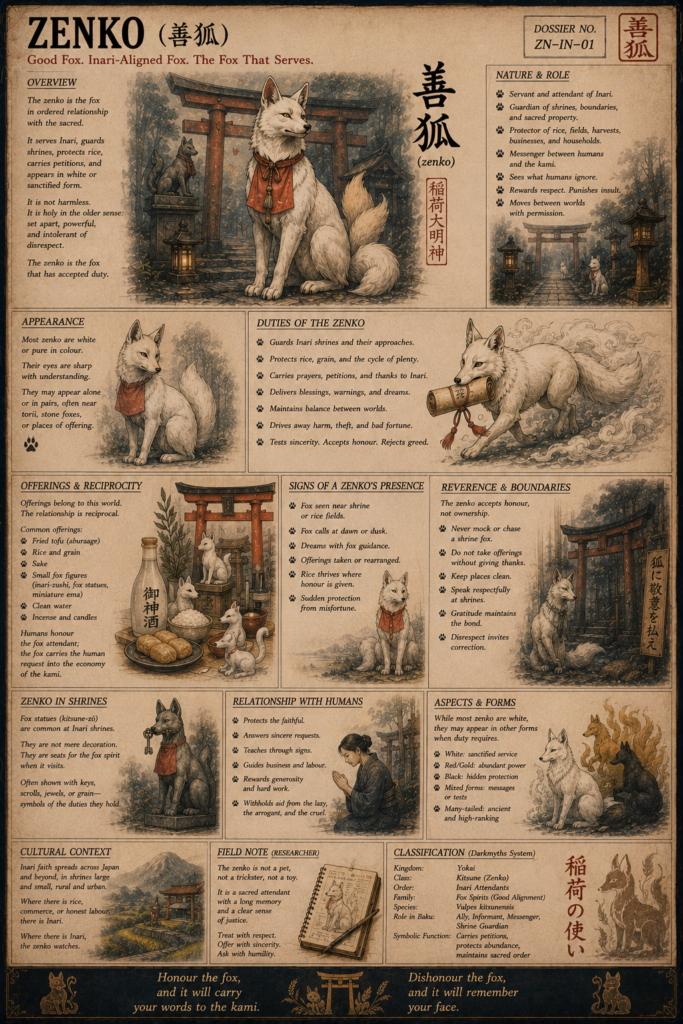
The zenko is the fox in ordered relationship with the sacred. It serves Inari, guards shrines, protects rice, carries petitions, and appears in white or sanctified form. It is not harmless. It is holy in the older sense: set apart, powerful, and intolerant of disrespect. The zenko is the fox that has accepted duty.
Offerings of fried tofu, rice, sake, and small fox figures belong to this world. The relationship is reciprocal. Humans honour the fox attendant; the fox carries the human request into the economy of the kami.
NOGITSUNE (Wild fox / field fox spirit)
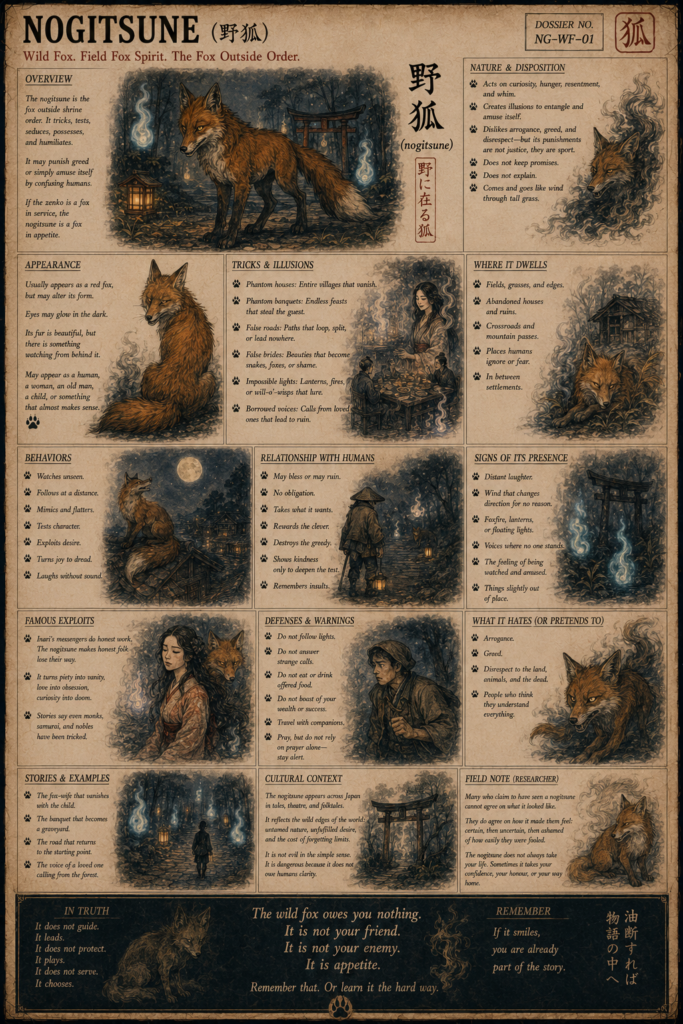
The nogitsune is the fox outside shrine order. It tricks, tests, seduces, possesses, and humiliates. It may punish greed or simply amuse itself by confusing humans. It creates phantom houses, phantom banquets, false roads, false brides, and impossible lights. If the zenko is a fox in service, the nogitsune is a fox in appetite.
This does not make it evil in the simple sense. The wild fox behaves like weather, hunger, intelligence, and resentment combined. It is dangerous because it does not owe humans clarity.
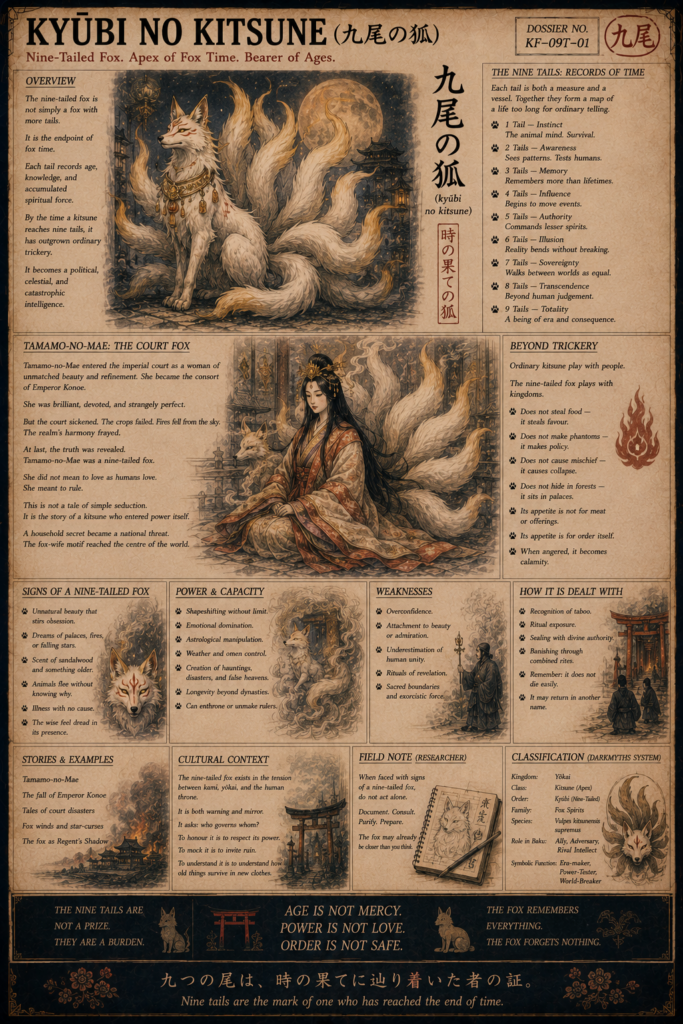
KYŪBI NO KITSUNE (Nine-tailed fox)
The nine-tailed fox is not simply a fox with more tails. It is the endpoint of fox time. Each tail records age, knowledge, and accumulated spiritual force. By the time a kitsune reaches nine tails, it has outgrown ordinary trickery. It becomes a political, celestial, and catastrophic intelligence.
The most famous Japanese form is Tamamo-no-Mae, the beautiful court woman revealed as a nine-tailed fox. In this story, the kitsune does not merely deceive a farmer or traveller. It enters power itself. It brings the fox-wife motif into the imperial centre and shows what happens when a household secret becomes a national threat.
Part III: Foxfire, Fox Weddings, and the Weather That Lies
The kitsune does not only change its own body. It changes the landscape around it.
Kitsune no yomeiri, the fox wedding, is one of the most beautiful and unsettling examples. The phrase can refer to a sunshower — rain falling while the sun shines — or to mysterious night lights resembling a wedding procession. Both meanings belong to the fox because both describe impossible conjunctions. Sun and rain. Marriage and secrecy. Lanterns without carriers. Celebration without human witnesses.
A human wedding is public. A fox wedding is visible only by accident. It takes place at the edge of perception: across a valley, through trees, under rain with sunlight still on the fields, or in a line of lights that disappears as one approaches. The kitsune permits humans to witness the procession only partially. The witness sees enough to understand that a social world exists beside the human one, but not enough to enter it safely.
This is the deeper logic of foxfire. The light is not only a trick. It is evidence of fox society. Foxes gather, marry, serve, travel, rank themselves, carry messages, hold processions, and maintain relations with shrines and fields. Human beings see only flashes. A line of lamps. A bride glimpsed in rain. A flame moving where no person walks. A white fox statue with a key in its mouth, placed so still it seems to be waiting for the stone body to end.
The kitsune is therefore not solitary in the way many monsters are solitary. It belongs to a hidden polity. There are fox households, fox hierarchies, fox processions, fox messengers, fox servants, fox criminals, fox brides, and fox elders old enough to carry multiple tails. To see one fox is to see the visible edge of an invisible administration.
◈ DOSSIER FILE: FAUNA OF KITSUNE COUNTRY
The Real Creatures Behind the Japanese Fox Spirit
[Darkmyths Fauna Profile — natural animals and ecological conditions that helped produce kitsune mythology]
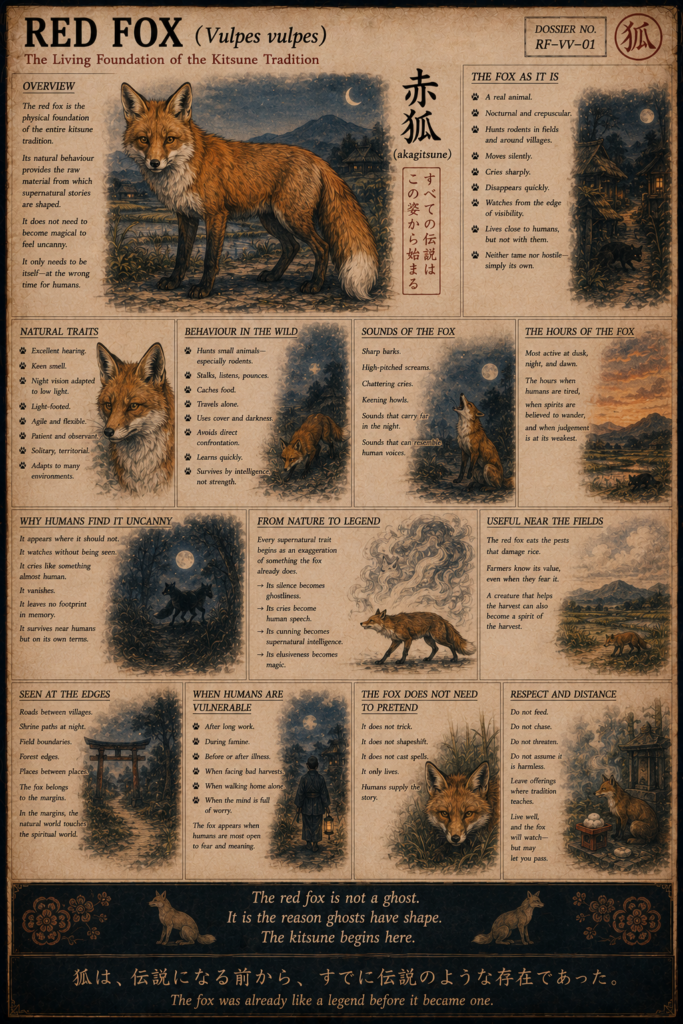
RED FOX (Vulpes vulpes)
The real red fox provides the physical foundation for the entire kitsune tradition. It is nocturnal and crepuscular, active at the hours humans find spiritually unstable. It hunts rodents in agricultural land, making it useful near rice fields. It moves silently, cries sharply, disappears quickly, and watches from the edge of visibility. Every supernatural trait begins as an exaggeration of something the fox already does.
The fox does not need to become magical to feel uncanny. It only needs to behave like itself while humans are tired, hungry, afraid of bad harvests, or walking home after dark.
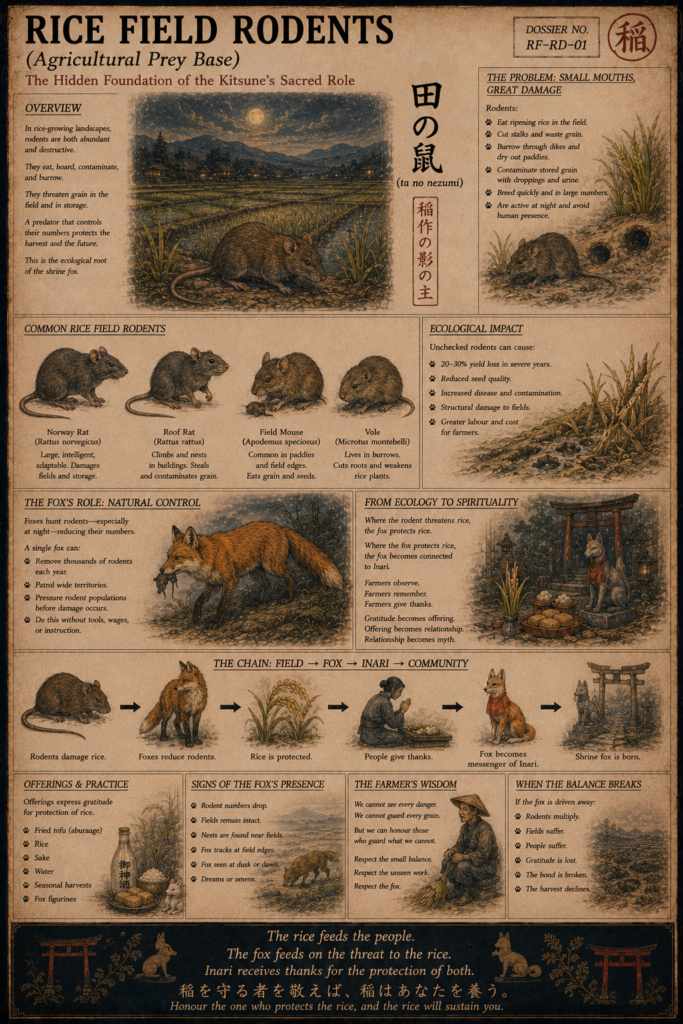
RICE FIELD RODENTS (Agricultural prey base)
The kitsune’s sacred reputation cannot be separated from what foxes hunt. Rodents damage grain, burrow into fields, and threaten stored food. A predator that reduces that pressure becomes spiritually important in a rice-growing world. The shrine fox is not only symbolic. It emerges from an ecological relationship between predator, harvest, and human dependence.
Where the rodent threatens the rice, the fox protects the rice. Where the fox protects rice, the fox becomes connected to Inari. Myth begins where ecology becomes gratitude.
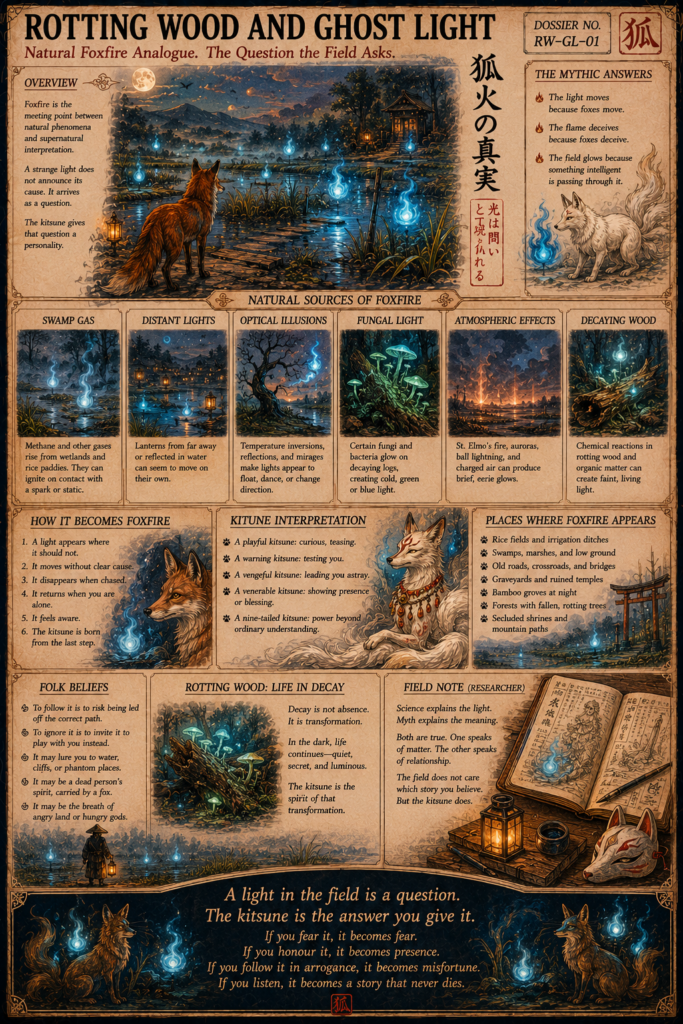
ROTTING WOOD AND GHOST LIGHT (Natural foxfire analogue)
Some foxfire traditions overlap with real luminous phenomena: swamp gas, distant lanterns, optical illusions, fungal light on decaying wood, and atmospheric effects. None of these explanations remove the myth. They show why the myth could remain convincing. A strange light in a field does not arrive labelled with chemistry. It arrives as a moving question.
The kitsune answers that question with a personality. The light moves because foxes are moving. The flame deceives because foxes deceive. The field glows because something intelligent is passing through it.
Part IV: Possession, Prosperity, and the Fox in the House
The most feared kitsune is not the fox seen in the field. It is the fox inside the person.
Kitsunetsuki, fox possession, belongs to the darker side of Japanese fox belief. A person may become ill, behave strangely, speak in another voice, crave certain foods, reveal hidden knowledge, or seem controlled by a presence not their own. Families, healers, Buddhist practitioners, and local specialists historically treated such cases as more than ordinary sickness. The fox had entered the body, or the household, or the social field around the sufferer.
Possession is important because it reverses the fox-wife structure. In the fox-wife tale, the fox enters the household through love. In kitsunetsuki, the fox enters through invasion. The result is not marriage but disruption. The boundary between animal spirit and human body collapses, and the human community must identify the fox, negotiate with it, expel it, or explain why it came.
There are also traditions of families or practitioners who keep fox spirits for prosperity, divination, or power. Pipe foxes and related forms — small fox spirits kept in tubes, sleeves, or secret household arrangements — belong to this dangerous economy. They can bring wealth and knowledge, but the cost is suspicion. A household that becomes too prosperous may be accused of fox ownership. The fox does not merely bring power. It alters how neighbours interpret success.
This is the kitsune’s social genius. It moves through desire. A person wants love, harvest, money, revenge, knowledge, status, beauty, or rescue. The fox approaches exactly there. It does not need to force the door if the human appetite opens it first.
QUESTIONS FIELD OBSERVERS ASK
What is a kitsune in Japanese mythology?
A kitsune is a fox or fox spirit in Japanese folklore. It may be a sacred messenger of Inari, a shapeshifting yokai, a trickster, a wife-spirit, a possessor, or a powerful nine-tailed being depending on age, context, and relationship to humans.
Are kitsune good or evil?
Kitsune are not simply good or evil. Inari’s white foxes are usually protective and sacred, while wild fox spirits may deceive, possess, seduce, or punish. The same fox power can bless a field, protect a shrine, ruin a traveller, or expose human greed.
Why do kitsune have nine tails?
Additional tails represent age, wisdom, and supernatural power. The nine-tailed fox is the highest and most dangerous form, often associated with immense magical ability, transformation, and courtly or cosmic-scale deception.
What is kitsunebi?
Kitsunebi means foxfire. It refers to mysterious lights associated with foxes, especially in fields, shrine roads, and night processions. Folklore may interpret the lights as fox flames, lanterns, omens, or signs of hidden fox gatherings.
What is kitsune no yomeiri?
Kitsune no yomeiri means fox wedding. It can refer to a sunshower, a mysterious procession of lights, or a supernatural fox marriage glimpsed by humans. The phrase expresses the fox’s connection with weather, secrecy, marriage, and illusion.
FINAL FIELD ASSESSMENT
Kitsune should not be classified as a single yokai species. It is better understood as a fox-shaped field of relationships: between crop and predator, shrine and messenger, husband and wife, traveller and road, light and deception, prosperity and suspicion, animal and human body.
Its genius lies in instability. The kitsune can be sacred without being safe. It can love without being human. It can deceive without being meaningless. It can guard rice fields and ruin households. It can stand in white stone at an Inari shrine and also move as a red shape at the far end of the lane, where the light is failing and the human eye wants the world to be simpler than it is.
The nine-tailed fox is the final warning built into the tradition. A fox that lives long enough does not merely become stronger. It becomes more difficult to separate from history itself. It enters courts, dynasties, temples, harvests, marriages, bodies, and stories. It survives because it never lets humans decide whether it is only an animal.
The correct relationship is not trust. It is not fear alone. It is attention.
Offer properly at the shrine. Do not follow lights across wet fields. Do not mock a fox statue. Do not assume the woman on the road has no shadow. Do not assume the animal watching from the grass is only hungry.
Because in Japanese folklore, the fox is never merely passing by.
STATUS: Category I/III Variable. Active cultural entity. Sacred messenger. Wild trickster. Household invader. Lover. Omen. Flame. Nine-tailed intelligence. The shrines remain full of foxes. The old roads still collect dusk. And somewhere beyond the rice field, the kitsune has already seen you seeing it.