WORLDWIDE FREE SHIPPING
Fictional Nature Field Journal — Gandaki Gorge, Nepal
“The river does not go down the mountain. The mountain rose around the river. This is a distinction that matters. One of them was here first. The other is still moving. You should think carefully about which one you are standing in.“ — Attributed to Pasang Wangdi Thakali, salt trader, Kagbeni, Upper Mustang, collected account, 1983
Classification Status: Active Theological Entity — Category 0 (Living Tradition with Physical Substrate)
Region of Presence: Kali Gandaki corridor, Kathmandu Valley watershed, Terai river systems, Nepal
Elevation Range: 60 metres (Narayani confluence, Terai) to 4,000+ metres (Upper Mustang, source region)
Earliest Known Reference: Rigveda, c. 1500–1200 BCE; Vedic oral tradition estimated 3,000+ years older
Primary Sacred Sites: Kagbeni, Muktinath, Taudaha, Nagpokhari, Gokarna tirthas, Kali Gandaki riverbed
Local Name: Nāga (Sanskrit, नाग); Klu (Tibetan); Nagini (female form)
Festival of Recognition: Nāga Panchami, fifth day of Shrawan (July/August), observed annually across Nepal
Forget everything you think you know about how mountains and rivers relate. The standard picture — rivers born in mountains, mountains preceding rivers, water flowing because the land tells it to — is not always how this world works. In Nepal, it is wrong in at least one extraordinary case.
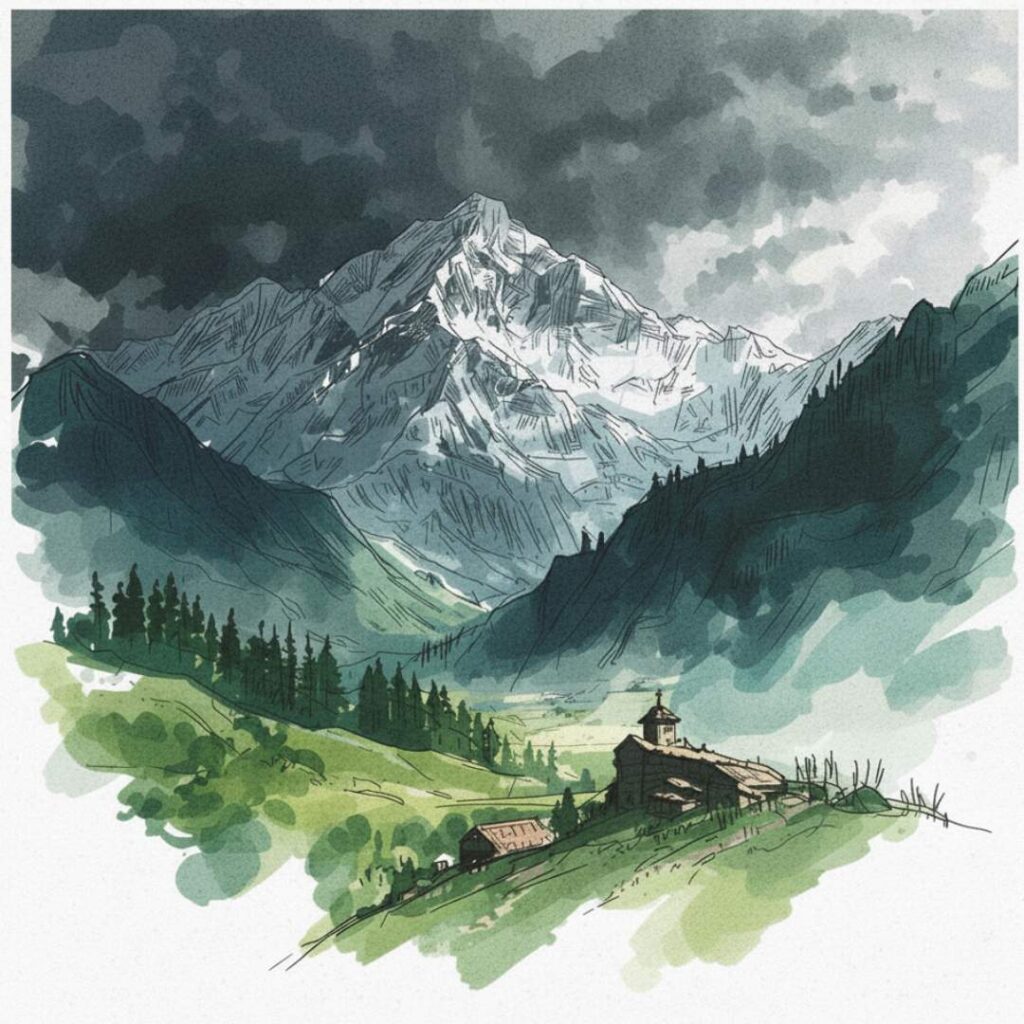
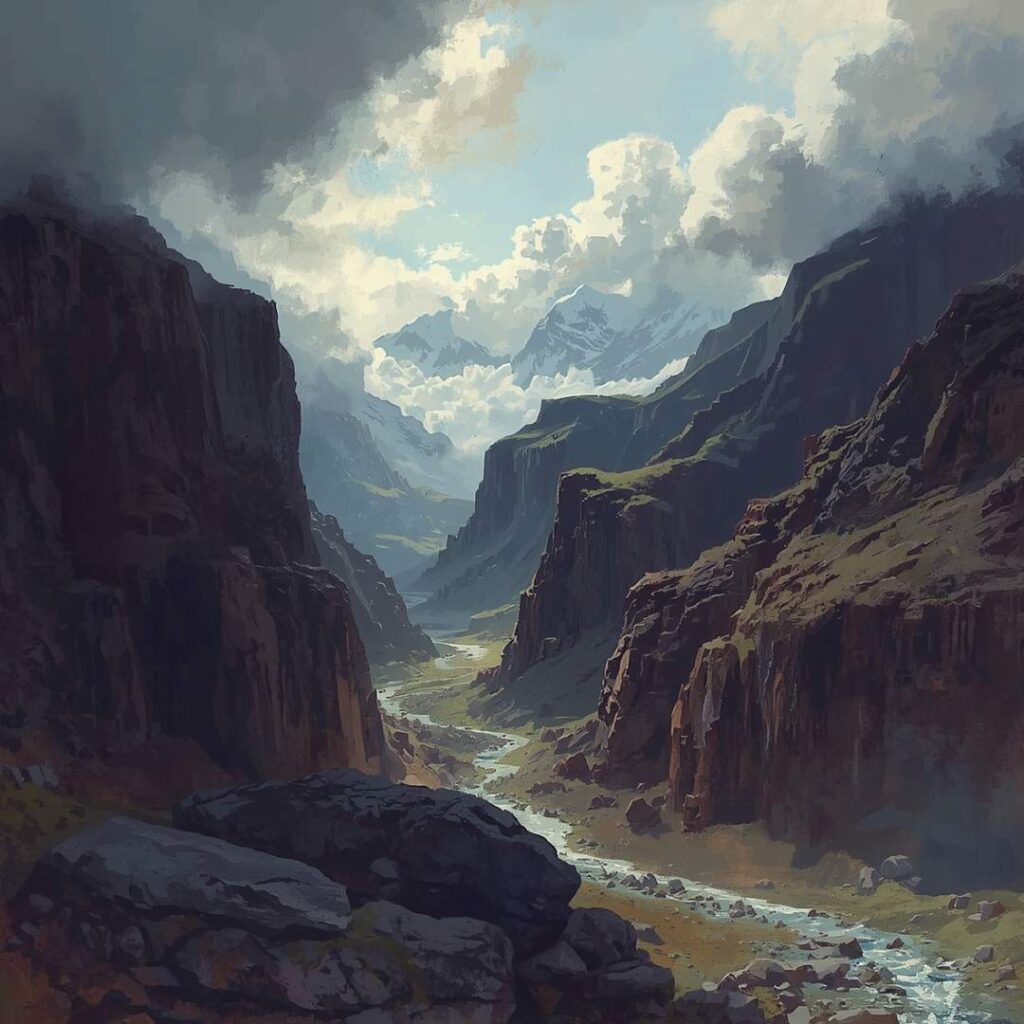
The Kali Gandaki River is older than the Himalayan mountains it appears to flow through. Its course was established tens of millions of years ago, when the Indian subcontinent had only just begun pushing northward into the Eurasian plate. As the mountains rose — as Dhaulagiri and Annapurna climbed from hills into giants — the river kept cutting. It cut faster than the mountains rose. It carved the deepest gorge on the planet: 5,571 metres of vertical relief between the valley floor and the summit of Annapurna I. Standing at the riverbed and looking up at the peak above is an experience no photograph captures.
The river runs between Dhaulagiri at 8,167 metres on the west and Annapurna at 8,091 metres on the east. As the mountains rose, the river cut through. One of them was here first.
This river is Nepal’s spine. It connects the high Tibetan plateau of Upper Mustang to the subtropical lowlands of the Terai in the south. It passes through Buddhist monasteries and Hindu pilgrimage routes, through gorges no road has ever followed, through sections that change colour with the season and the snowmelt. And in its black riverbed stones, preserved in spiral form, are the fossilised bodies of creatures that died in a shallow tropical sea 150 million years ago — before the mountains existed, before the land existed, before any of this was possible.
The river knows what was here before the world was rearranged. And in its deep channels, something the people of this region have known about for longer than any text can accurately date still moves at night, trailing the dark water behind her.
They call her the Nāga. The River’s Own.
Part I: The Woman in the Water
The Nāga is written into the architecture of Hindu and Buddhist Nepal. You cannot discuss the river, the rain, the fertility of the soil, or the structure of the cosmos without discussing her. She is not adjacent to the theology. She is load-bearing.
The Nāgas are semi-divine serpent beings first depicted in Vedic Hindu mythology and oral folklore from at least 5,000 BCE. In Hindu cosmology, they are born from the sage Kashyapa and his wife Kadru, making them half-siblings to the Garuda eagle-beings. That sibling relationship became eternal enmity: sky versus water, eagle versus serpent, the aerial and the subterranean locked in permanent opposition. Vishnu rides the Garuda. Vishnu also rests between the cycles of creation on the great Nāga Shesha. The god of preservation holds both in balance — but it is the Nāga who carries him while he sleeps.
In Buddhist tradition, the Nāga is repositioned but remains essential. The Nāga king Mucalinda sheltered the meditating Buddha from monsoon rain, coiling beneath him and spreading wide to form a living canopy. According to tradition, the highest Buddhist teachings were given to Nagarjuna not by a god or a human, but by Nagaraja — the Nāga king at the bottom of the ocean — who had been guarding them until humanity was ready. The deepest wisdom available to the human mind was entrusted to creatures that live in water. Before we deserved what we needed, the river kept it safe.
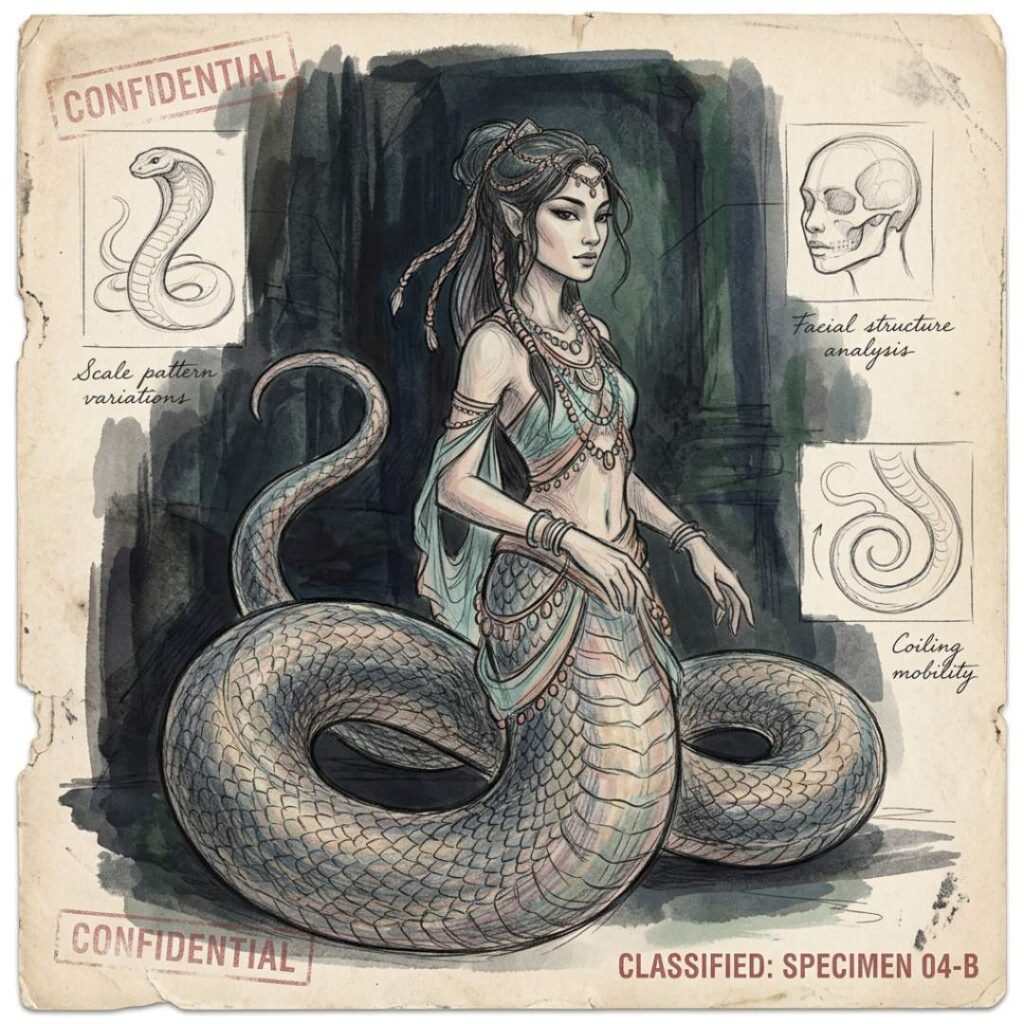
The Nāga of Nepal’s river tradition is predominantly female. Not the cobra-king of temple reliefs or the thousand-headed cosmic serpent of Sanskrit texts, but the Nagini — a woman from the waist up, a serpent below, moving through the water with the unhurried confidence of something that has been the river’s permanent resident since before it was named. Her upper body surfaces. Her lower body does not. What you see of her is what she permits you to see.
“The Nāgas are not worshipped out of fear. They are worshipped because people understand what they are. Remove the Nāgas and the water stops. Remove the water and everything else follows. We are grateful, not frightened.“ — Attributed to Ramesh Prasad Shrestha, Newar priest, Taudaha sacred pond, Kathmandu, 2014
◈ DOSSIER FILE: THE NĀGA
Aqua Nagini Gandakiensis — “The River’s First Resident”
[Darkmyths Classification: Category 0 — Living Tradition with Physical Substrate and Verified Geological Correlation]
PHYSICAL PROFILE
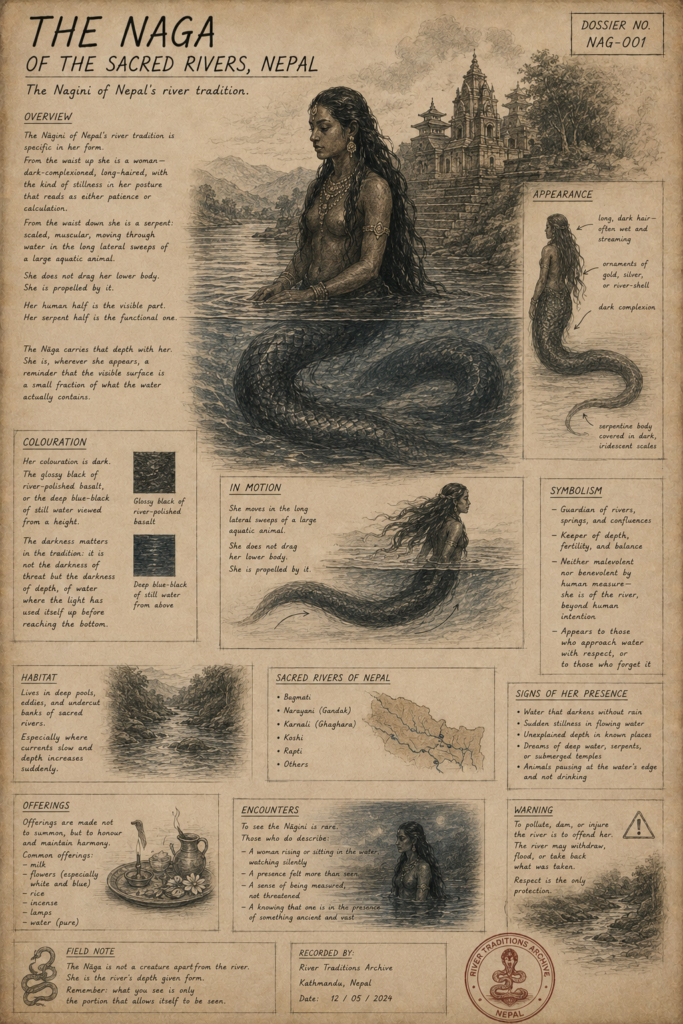
The Nagini of Nepal’s river tradition is specific in her form. From the waist up she is a woman — dark-complexioned, long-haired, with the kind of stillness in her posture that reads as either patience or calculation. From the waist down she is a serpent: scaled, muscular, moving through water in the long lateral sweeps of a large aquatic animal. She does not drag her lower body. She is propelled by it. Her human half is the visible part. Her serpent half is the functional one.
Her colouration is dark. The glossy black of river-polished basalt, or the deep blue-black of still water viewed from a height. The darkness matters in the tradition: it is not the darkness of threat but the darkness of depth, of water where the light has used itself up before reaching the bottom. The Nāga carries that depth with her. She is, wherever she appears, a reminder that the visible surface is a small fraction of what the water actually contains.
Her hair moves in water in ways that do not follow currents. This detail appears in multiple Thakali and Newar accounts with enough consistency that it becomes a field marker: if you see something at the river surface whose hair moves against the flow, you are seeing something the river is carrying, not something the river is moving.
She is not aggressive in most accounts. She assesses. When a human being appears at the water’s edge, she is the one deciding what happens next, and her criteria for that decision are not explained in any text. They are inferred from outcomes: people who approach the river with demonstrated respect are watched and left alone. People who approach the river with the assumption that it belongs to them are given an experience that corrects that assumption.
DOMAIN AND DWELLING
The Nāga lives in Patala — the deepest of the underworlds in Hindu cosmology. But Patala in the texts is not a place of punishment or darkness. It is described as more beautiful than heaven: cities of gem and gold, gardens of impossible colour, treasures beyond mortal counting. The Nāga capital, Bhogavati, is a palace city where the Nagarajas hold courts as magnificent as anything in the celestial realms. The Nāga does not live underground because she is banished there. She lives there because the deep places are genuinely superior to what is available at the surface. She surfaces occasionally. She does not stay.
In the specific Nepal river tradition, her domain is the deep channel — the part of the river unchanged by monsoon flood or dry season drought, the part that was flowing when the sea creatures now preserved as Shaligrams were still alive. Everything above it is seasonal. The deep channel is permanent. The Nāga’s address.
In the Kathmandu Valley, she inhabits the sacred ponds: Taudaha, Nagdaha, Nagpokhari. These are the last remnants of a much larger body of water — a lake that the valley once was in its geological past. The Nāga in these ponds is not a visitor. She is the original occupant, staying in the last pieces of a home that was drained around her.
THE RAIN
The Nāga’s most practically urgent function is rain. Prosperity and well-being in the valley is tied to rainfall, and the Nāgas are responsible for it. During the great chariot festival of Bungdyeo, it is made explicit: only the Nāgas possess the power to cause rain. As long as they are content, drought will not come. When there is no rain, the people bring out texts written in Nāga blood from Swayambhu and read to them. When the serpents are appeased, they release the rain.
The logic beneath this tradition is precise. Large serpents emerge with the monsoon — they surface when the ground saturates, when the temperature and moisture conditions of a rain event arrive. The appearance of cobras at field margins and the arrival of the monsoon are synchronous in the Terai and the valley floor. The tradition that attributes rain to the Nāga is recording a real ecological correlation and expressing it as causation. Whether the causation is literal or not, the correlation is measurable.
SEISMIC LANGUAGE
Earthquakes in the Kathmandu Valley are, in tradition, the Nāga Raja shaking his head. The valley floor is ancient lake sediment — soft, water-saturated deposits that amplify seismic waves far beyond what solid rock would permit. The 2015 Gorkha earthquake demonstrated this catastrophically: the valley shook harder than its distance from the epicentre should have produced, precisely because of its substrate. That substrate is lakebed. The Nāga’s former home. The valley shakes hardest where it was once water, and the tradition of the Nāga shaking the ground from below is the most accurate description possible, in pre-seismological language, of what water-saturated lake sediment does under tectonic stress.
STATUS: Category 0. No reclassification appropriate. The Nāga is not a mystery to be solved. She is a system to be understood.
Part II: The Valley That Was a Lake
This is a geological fact confirmed by modern science: the Kathmandu Valley was, approximately 30,000 years ago, a lake. Its floor is ancient lacustrine sediment — fine-grained, organically rich, the kind of deposit that only forms under standing water over long periods of time. The lake drained through natural erosion at the southern end of the valley, and the resulting wetland was gradually settled by vegetation, then by people.
The Nāga mythology of the Kathmandu Valley says exactly this, in different words.
The valley, in this tradition, was called Nagdaha — Lake of the Serpents. It was inhabited by Nāgas. A bodhisattva named Manjushree drained the lake by cutting through the southern barrier with his sword, disturbing the Nāgas from their depths. After the valley was established, twelve great Nāgas were assigned to protect the watershed — one per sacred river confluence site, one per tirtha, the twelve hydraulic nodes on which the valley’s water cycle depends.
The Chobhar gorge exists. It is the narrow break in the valley’s southern wall through which the Bagmati River now exits. The mythology of Manjushree’s sword cutting the gorge is describing a real geological event in ceremonial language. The Nāgas disturbed from the lakebed are the real animals of the ancient lake, preserved in cultural memory as prior occupants. The twelve Nagarajas assigned to the twelve river confluence points are not a round number chosen for aesthetic reasons. The valley has twelve principal tributary confluences. The mythology counted them.
“My family has lived in this neighbourhood longer than the street has had its name. The street is called Tahachal — the place of serpents. We did not name it as a story. We named it because they were there.“ — Attributed to Deepa Maharjan, Newar householder, Tahachal, Kathmandu, 2018
The treasures of Pashupatinath — Nepal’s most sacred Hindu temple complex, a UNESCO World Heritage Site on the Bagmati River’s banks — are kept under the care of the Vasuki Nāga. The custodian of the most important temple treasury in Nepal is not a human institution. It is a river serpent. This is a statement about durability: humans and their institutions come and go. The river remains.
◈ DOSSIER FILE: THE SERPENTS — NĀGA IN MORTAL FORM
Real Snakes as Vessels, Disguises, and Companions
[Darkmyths Fauna Profile — Nepal’s living serpents as the Nāga’s physical expressions]
The Nāga does not always announce herself. When she moves through the human world, she most often does so in the form of a living snake — a form so common, so present in the daily life of Nepal’s river valleys and forest margins, that most people who encounter her do not know they have. The tradition is specific: any cobra, any large serpent found near a sacred site, a river, a field’s irrigation channel, or a household threshold may be a Nāga walking among the ordinary. Harming it is a serious transgression. On Nāga Panchami, the prohibition on digging extends specifically to this concern — every action that disturbs the soil risks disturbing a Nāga travelling beneath it.
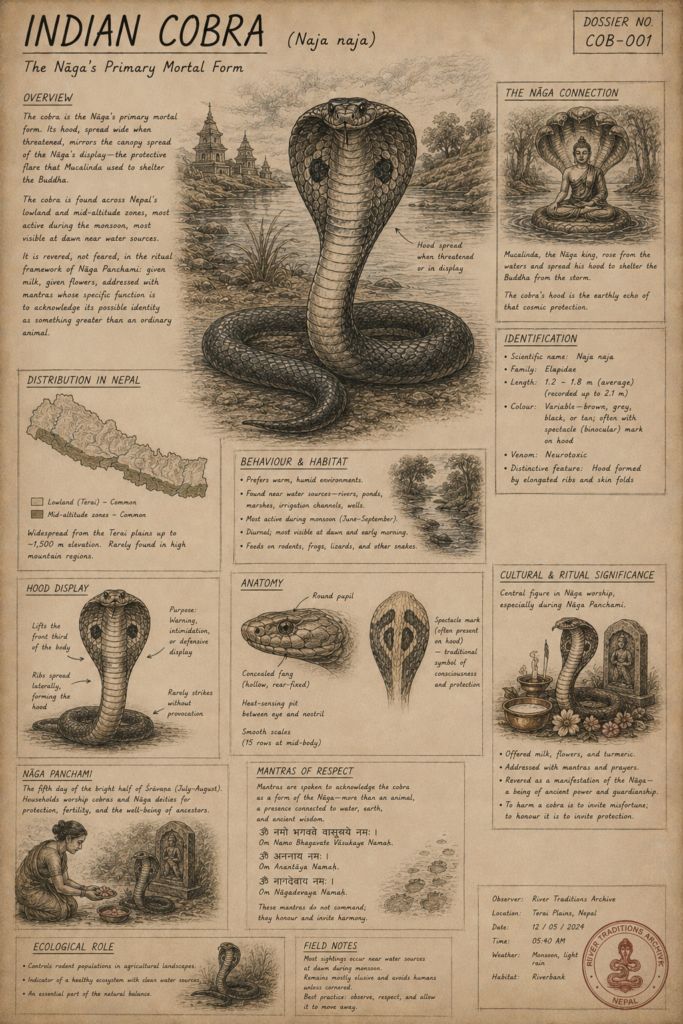
INDIAN COBRA (Naja naja)
The cobra is the Nāga’s primary mortal form. Its hood, spread wide when threatened, mirrors the canopy spread of the Nāga’s display — the protective flare that Mucalinda used to shelter the Buddha. The cobra is found across Nepal’s lowland and mid-altitude zones, most active during the monsoon, most visible at dawn near water sources. It is revered, not feared, in the ritual framework of Nāga Panchami: given milk, given flowers, addressed with mantras whose specific function is to acknowledge its possible identity as something greater than an ordinary animal.
The cobra’s venom is fast and serious. This is not separate from its sacred status — it is inseparable from it. A Nāga that carries death in her body is a Nāga whose terms of engagement must be respected. The offering of milk is partly practical: cobras, while not obligate milk-drinkers, will approach the offering, and approaching without aggression is understood as the Nāga accepting acknowledgement. The ritual works whether the cobra is a cobra or something more. In either case, the appropriate behaviour is the same.
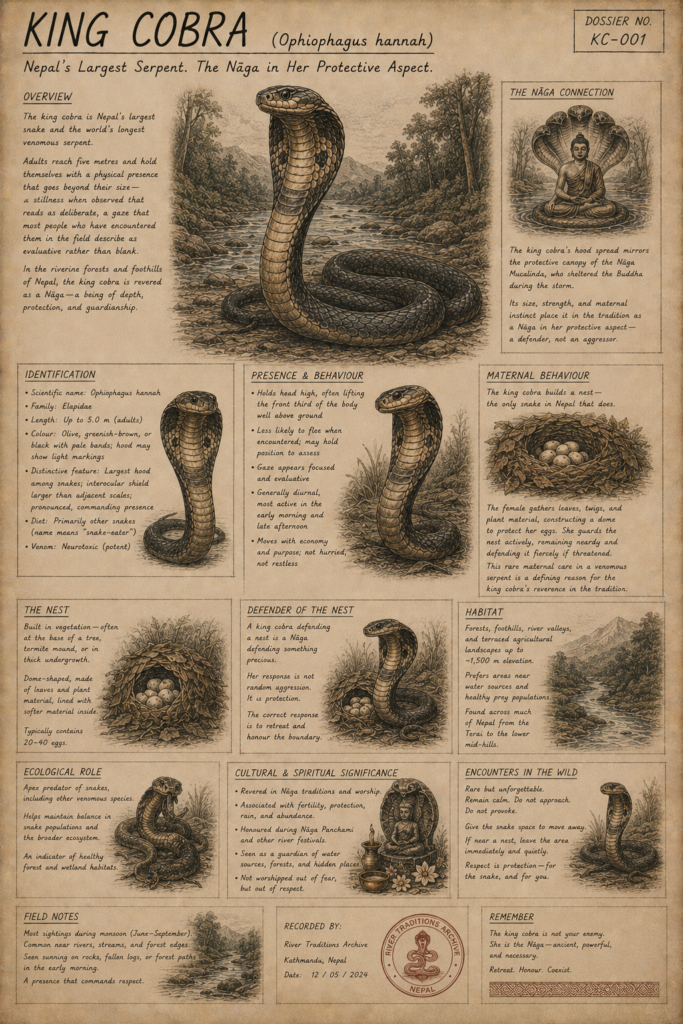
KING COBRA (Ophiophagus hannah)
The king cobra is Nepal’s largest snake and the world’s longest venomous serpent. Adults reach five metres and hold themselves with a physical presence that goes beyond their size — a stillness when observed that reads as deliberate, a gaze that most people who have encountered them in the field describe as evaluative rather than blank. The king cobra builds a nest — the only snake in Nepal that does — and guards it actively. This maternal behaviour, so unusual in a venomous serpent, positions it in the tradition as a Nāga in her protective rather than threatening aspect. A king cobra defending a nest is a Nāga defending something precious. The correct response is to retreat and honour the boundary.
King cobras are shy by disposition and show themselves rarely. In the Tharu tradition of the western Terai, a sighting of a king cobra in the open — not fleeing, not threatened, simply present — is considered a message. Not a warning. A communication requiring interpretation. The meaning depends on location and context: a king cobra at the water’s edge during the dry season means the water is threatened. A king cobra crossing a field margin in early monsoon means the harvest will be good. Whether this is pattern recognition accumulated over generations, or accurate transmission of actual Nāga communication, the tradition does not distinguish between the two, and neither does Darkmyths.
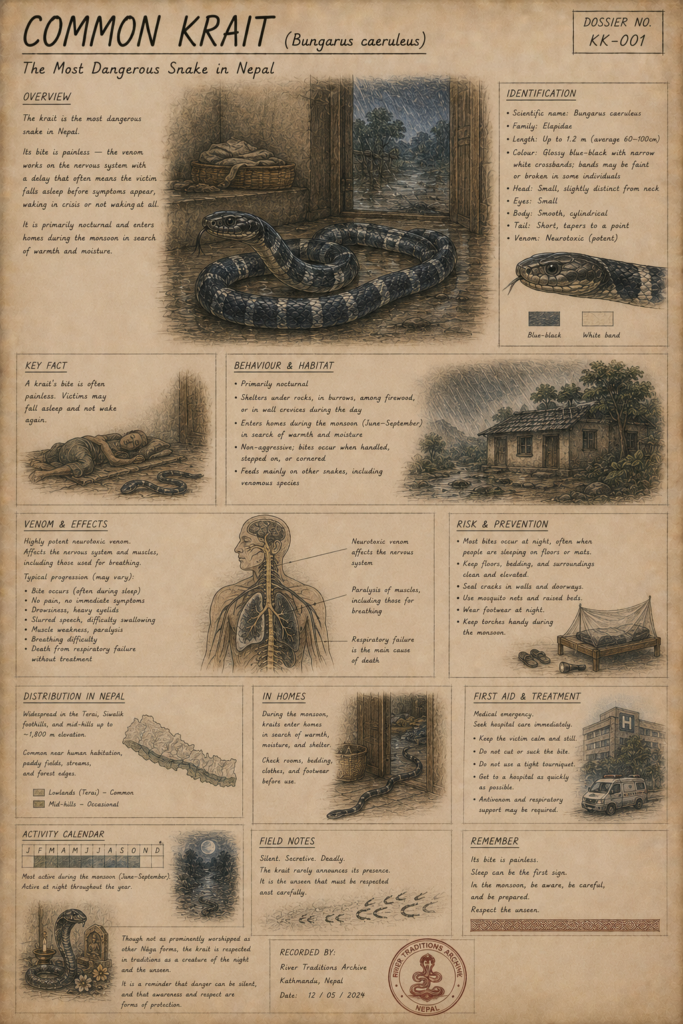
COMMON KRAIT (Bungarus caeruleus)
The krait is the most dangerous snake in Nepal. Its bite is painless — the venom works on the nervous system with a delay that often means the victim falls asleep before symptoms appear, waking in crisis or not waking at all. It is primarily nocturnal and enters homes during the monsoon in search of warmth and moisture.
In the tradition, the krait in the home is the Nāga at the threshold — not entered to attack, but testing whether the household maintains proper acknowledgement. Families that observe Nāga Panchami correctly, that leave offerings at the field margins, that do not kill snakes casually, find that kraits in the home move through and leave. Families that have ignored the tradition find the krait in a bed. The Darkmyths reading of this is not supernatural. Kraits enter warm, dry spaces. They encounter the sleeping before the waking. The tradition builds a behavioural protocol around a genuine environmental risk and encodes it in the Nāga’s moral logic.
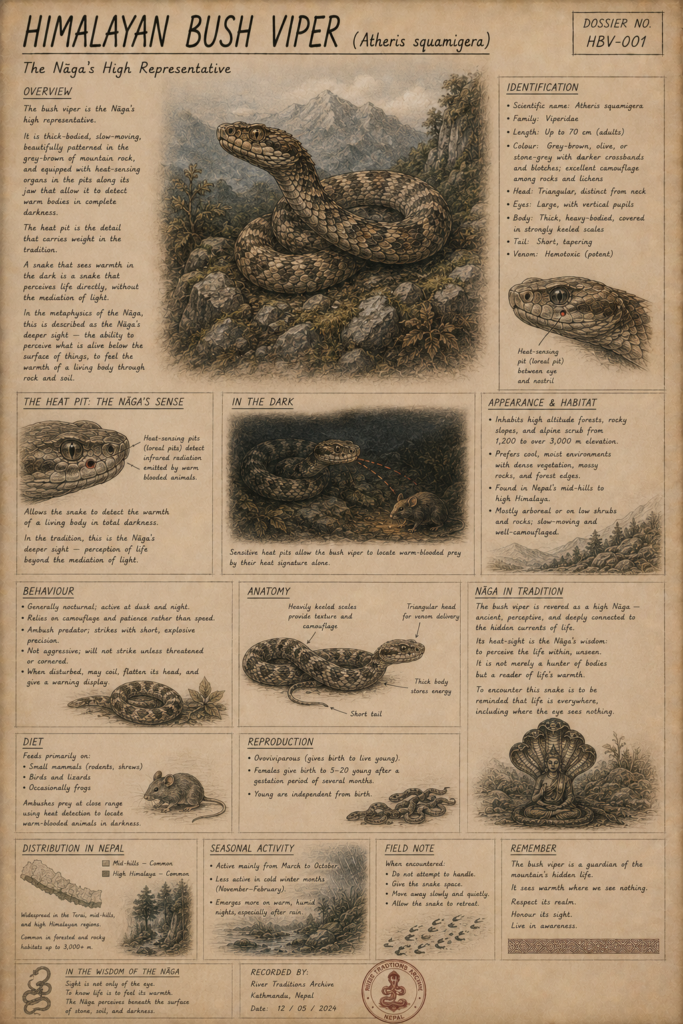
HIMALAYAN BUSH VIPER (Atheris squamigera)
The bush viper is the Nāga’s high representative. It is thick-bodied, slow-moving, beautifully patterned in the grey-brown of mountain rock, and equipped with heat-sensing organs in the pits along its jaw that allow it to detect warm bodies in complete darkness. The heat pit is the detail that carries weight in the tradition. A snake that sees warmth in the dark is a snake that perceives life directly, without the mediation of light. In the metaphysics of the Nāga, this is described as the Nāga’s deeper sight — the ability to perceive what is alive below the surface of things, to feel the warmth of a living body through rock and soil.
Pilgrims on the Kali Gandaki route encounter pit vipers sunning on the trail stones in early morning. The appropriate response in the tradition is to wait — to allow the snake the warmth it is gathering before moving past it. This is courtesy extended to a traveller on a shared road. The tradition holds that a Nāga encountered in her mountain form and given space will mark the pilgrim as acknowledged, and the pass above will be safer for it.
Part III: What the Stones Are Saying
The Shaligram is the single most important physical object in this entire field report. Everything returns to it.
A Shaligram is a black river stone. Inside it, coiled in the stone’s core, is an ammonite — the fossilised shell of a marine cephalopod that went extinct 66 million years ago. The Kali Gandaki River is the only place in the world where they are found in this specific form, these specific numbers, washed free from the surrounding rock by the river’s force and collected in the riverbed between Kagbeni and the Tibetan border. Some are small enough to hold in a palm. Some reach two metres in diameter, resting in the riverbed like the stones of a sunken architecture.
Hindus consider each Shaligram a natural manifestation of Vishnu. Finding one is a divine blessing. Pilgrims walk the Kali Gandaki corridor every year specifically to search for them — bending over the riverbed, lifting stones, looking for the spiral within.
The spiral is the ammonite’s shape. It is also the shape of a coiled serpent. The Shaligram found in the world’s deepest gorge, in a river older than the mountains, is a coiled dark form in black stone — the Nāga’s signature left in the rock of a sea that the mountains buried.
This is the Darkmyths reading: someone, at some early point in this pilgrimage tradition, found a coiled black stone in the riverbed and understood that it recorded something ancient and aquatic that had been here before the mountains. The Nāga tradition gave that discovery its theology. The Shaligram is the evidence. The river is the context. The ammonite is the message, sent 150 million years ago, that the Nāga’s territory is older than everything that now surrounds it.
“A sadhu came to collect Shaligrams from our riverbank. I asked what he was looking for. He said: the god. I said: the god is in these stones? He said: the god is what made these stones. The stone is the message. You are standing where the message was sent.“ — Attributed to Ratna Kumari Gurung, Kagbeni, Upper Mustang, 2011
◈ DOSSIER FILE: THE RIVER TERRITORIES
Three Zones — The Nāga’s Vertical Kingdom
[Darkmyths Geographic Profile — Mustang plateau to the Terai river systems]
The Nāga’s range is the river itself. From source to confluence, from the high Tibetan plateau to the subtropical lowlands, her territory follows the water at every altitude.
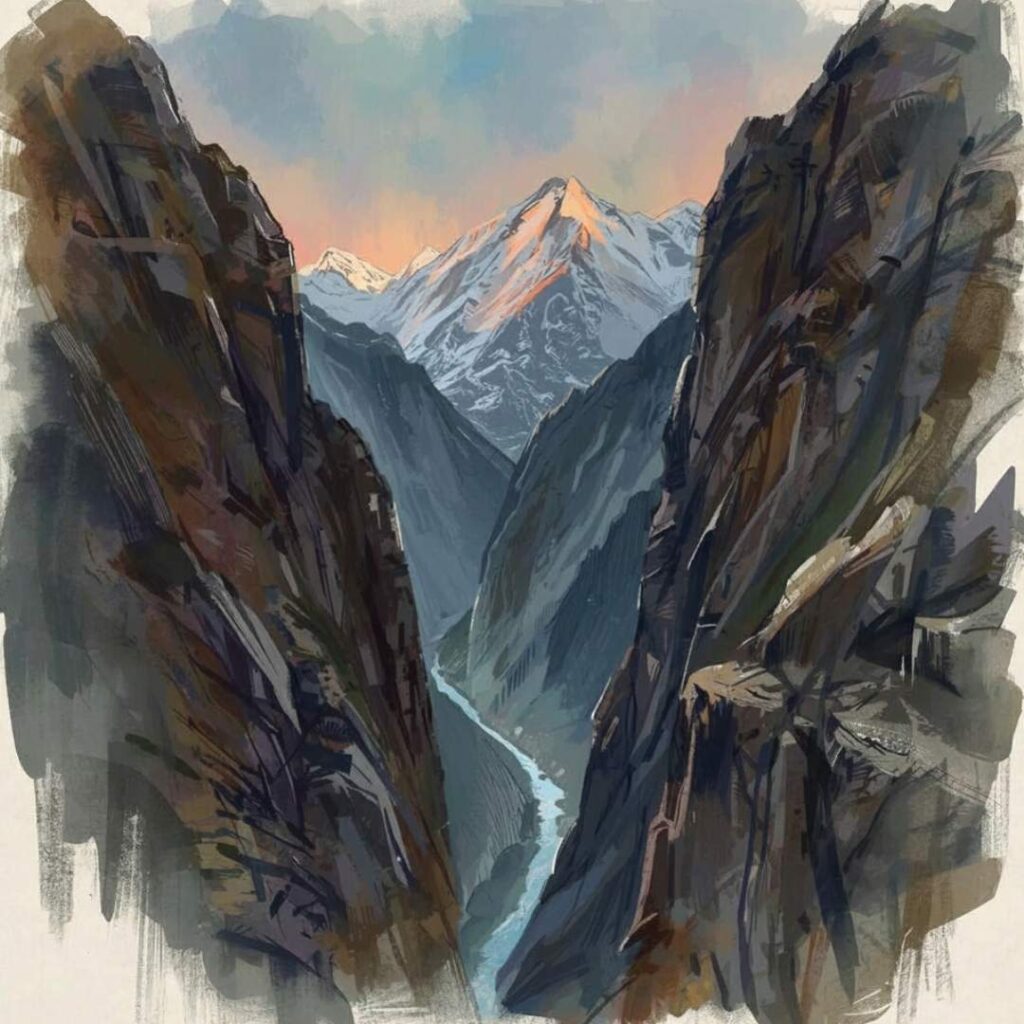
TERRITORY I: THE KALI GANDAKI GORGE
The gorge between Tatopani and Kagbeni is the Nāga’s oldest ground — the place where the river’s pre-Himalayan history is physically present in the cliff walls. The strata here span hundreds of millions of years. Walking through the gorge is literally a walk through geological time: you pass Jurassic marine deposits, Cretaceous clastics, Miocene terrestrial formations, all stacked in sequence around you.
The Shaligrams are found in the middle stretch. Pilgrims bend over the riverbed between Kagbeni and the village below, turning over stones, searching for the spiral. The tradition of Shaligram collection is unbroken in any living memory. It will likely outlast every institution currently operating in the country.
The narrow canyon section between Kalopani and Ghasa is where the gorge walls come closest and the river runs fastest and deepest. Thakali traders who worked this route describe this stretch differently from any other — specifically, the sound the river makes here at night. Not louder. Not different in any way that can be described as unusual water behaviour. But deeper, carrying a register felt in the chest before it registers in the ears. A frequency under the white-water noise that experienced river-people describe as the river’s other voice. The Darkmyths position is that the resonance properties of a narrow stone canyon around a fast-moving body of water at certain temperatures and volumes can produce standing wave phenomena. The tradition’s position is that the gorge here is narrower than the Nāga, and the sound is her moving through it.
Both are accurate.
TERRITORY II: THE KATHMANDU VALLEY
The sacred ponds — Taudaha, Nagdaha, Nagpokhari — are the last remnants of the ancient lake. In dry season, they are modest: reed-fringed, bird-rich, quiet. In the monsoon, they expand. The distinction between pond and surrounding land softens. The water takes back what the drainage season took from it, briefly, before it recedes again.
Taudaha is the largest, roughly five hectares, southwest of the city. The serpent king Karkota is said to have built his palace here. The modern city has grown close to its edges, but the pond itself remains as it was — which is to say, approximately as the lakebed looked when the water first retreated to this size, thousands of years ago. On Nāga Panchami, thousands of people come to the water’s edge with offerings of milk, flowers, and sandalwood incense. The fragrance of sandalwood is specifically beloved by the Nāga deity — in ritual instruction, it is the scent that draws her to the surface.
TERRITORY III: THE LOWER RIVER — NARAYANI AND THE TERAI
The Kali Gandaki flows south through the gorge, through the Pokhara valley, joins the Trishuli to form the Narayani, and then enters the Terai lowlands — the subtropical belt along Nepal’s southern border. The Narayani passes through Chitwan National Park, one of Asia’s most significant wildlife preserves.
In the Narayani’s deep channels live gharial — endangered fish-eating crocodiles that reach five metres, their narrow snouts lined with interlocking teeth, their bodies built entirely for the river’s deep current. The gharial is the most Nāga-like creature in Nepal’s living fauna: elongated, aquatic, surfacing briefly before returning to depth, its movement through deep water precisely the sinuous disturbance that tradition describes as the Nāga’s passage. Whether the gharial contributed to the Nāga’s physical form in the tradition’s earliest layer, or whether the Nāga tradition made the gharial sacred, the two have been associated long enough that the distinction is mostly historical.
The Narayani’s oxbow lakes and swamp margins hold pythons, monitor lizards, and mugger crocodiles alongside the gharial. The lower river is the Nāga’s most ecologically complex territory — the place where her physical forms are densest in the landscape, where the real and the mythological overlap most visibly.
◈ DOSSIER FILE: FLORA OF THE SACRED WATER
The Plants That Mark the Nāga’s Presence
[Darkmyths Botanical Profile — species of ritual and ecological significance along the Nāga’s vertical range]
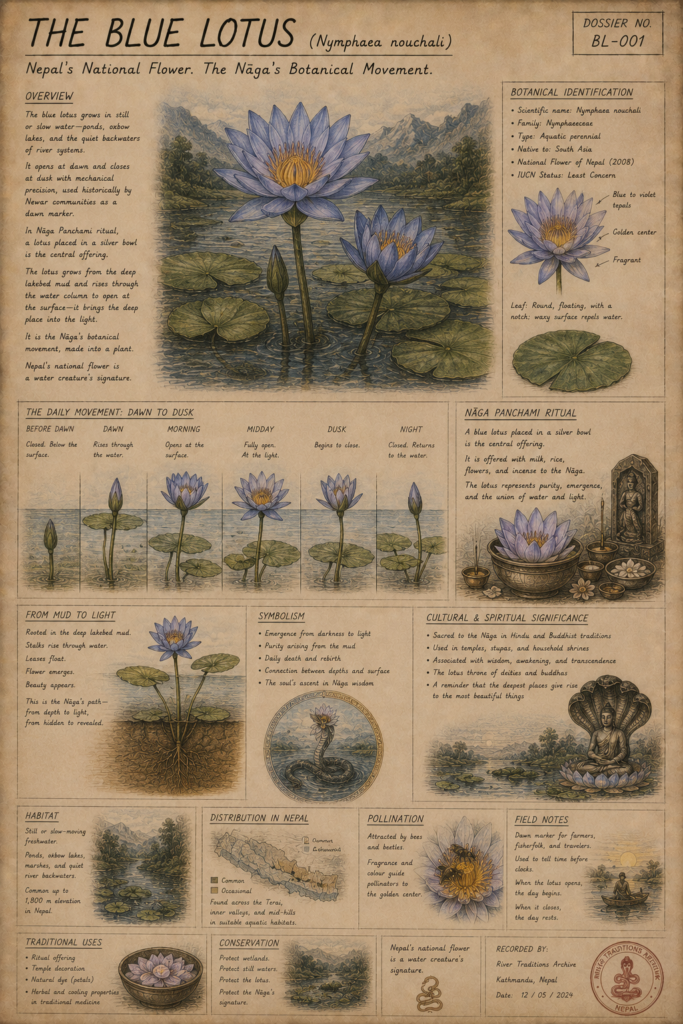
THE BLUE LOTUS (Nymphaea nouchali — Nepal’s National Flower)
The blue lotus grows in still or slow water — ponds, oxbow lakes, the quiet backwaters of river systems. It opens at dawn and closes at dusk with mechanical precision, used historically by Newar communities as a dawn marker. In Nāga Panchami ritual, a lotus placed in a silver bowl is the central offering. The lotus grows from the deep lakebed mud and rises through the water column to open at the surface — it brings the deep place into the light. It is the Nāga’s botanical movement, made into a plant.
Nepal’s national flower is a water creature’s signature.
THE RUDRAKSHA TREE (Elaeocarpus ganitrus)
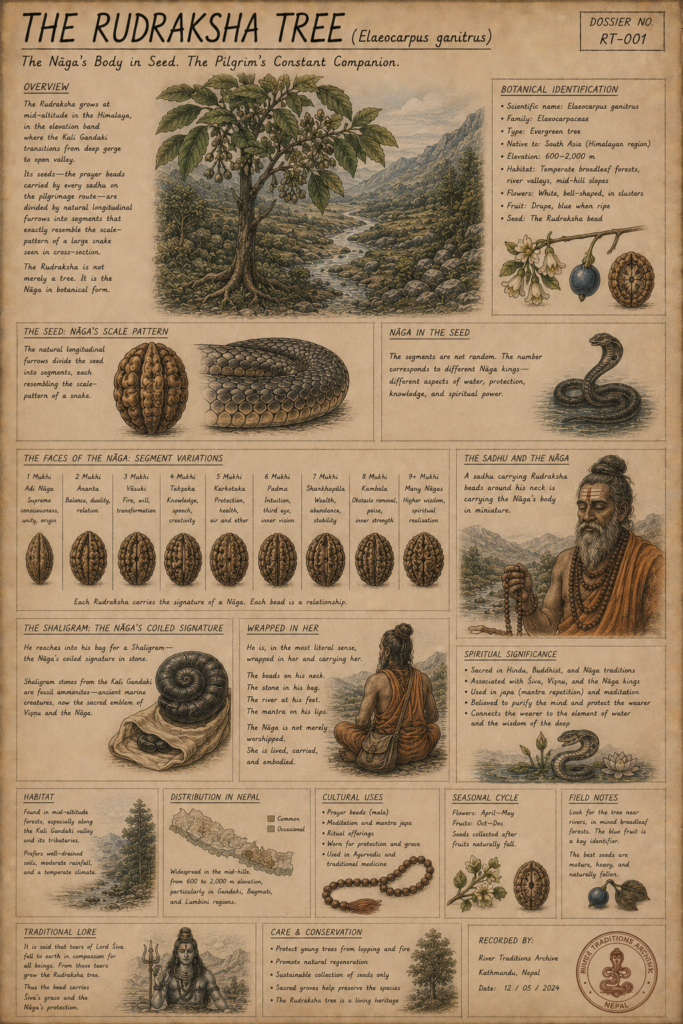
The Rudraksha grows at mid-altitude, in the elevation band where the Kali Gandaki transitions from deep gorge to open valley. Its seeds — the prayer beads carried by every sadhu on the pilgrimage route — are divided by natural longitudinal furrows into segments that exactly resemble the scale-pattern of a large snake seen in cross-section. The number of segments varies, and each variation corresponds to a different Nāga king, a different aspect of water or sacred knowledge. A sadhu carrying Rudraksha beads around his neck is carrying the Nāga’s body in miniature. He reaches into his bag for a Shaligram — the Nāga’s coiled signature in stone. He is, in the most literal sense, wrapped in her and carrying her.
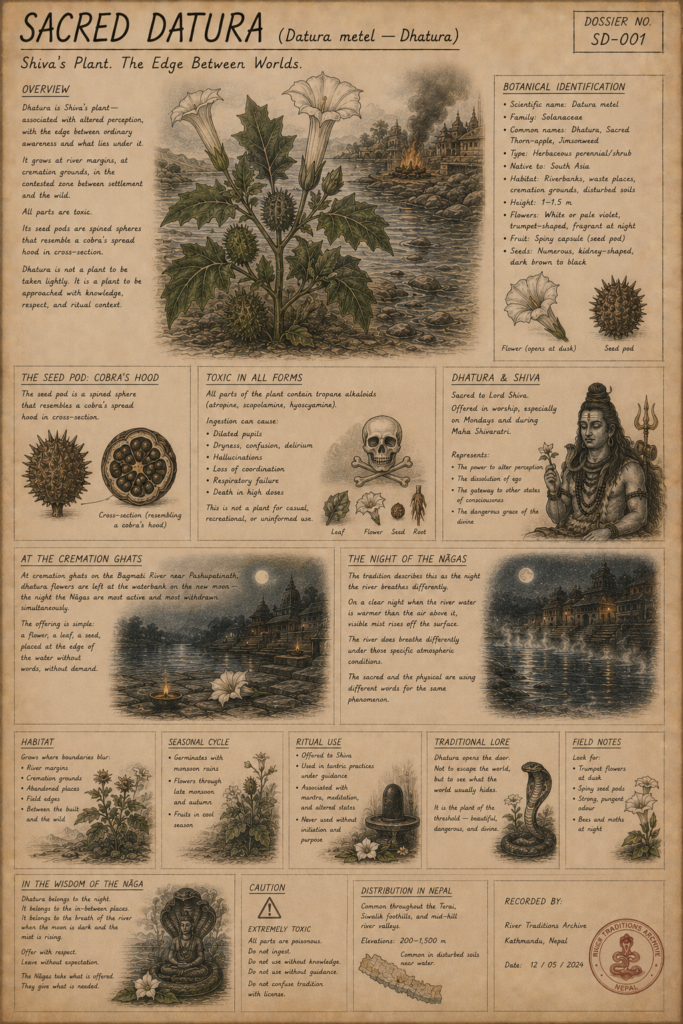
SACRED DATURA (Datura metel — Dhatura)
Dhatura is Shiva’s plant — associated with altered perception, with the edge between ordinary awareness and what lies under it. It grows at river margins, at cremation grounds, in the contested zone between settlement and the wild. All parts are toxic. Its seed pods are spined spheres that resemble a cobra’s spread hood in cross-section.
At cremation ghats on the Bagmati River near Pashupatinath, dhatura flowers are left at the waterbank on the new moon — the night the Nāgas are most active and most withdrawn simultaneously. The tradition describes this as the night the river breathes differently. On a clear night when the river water is warmer than the air above it, visible mist rises off the surface. The river does breathe differently under those specific atmospheric conditions. The sacred and the physical are using different words for the same phenomenon.
TULSI (Ocimum tenuiflorum — Holy Basil)
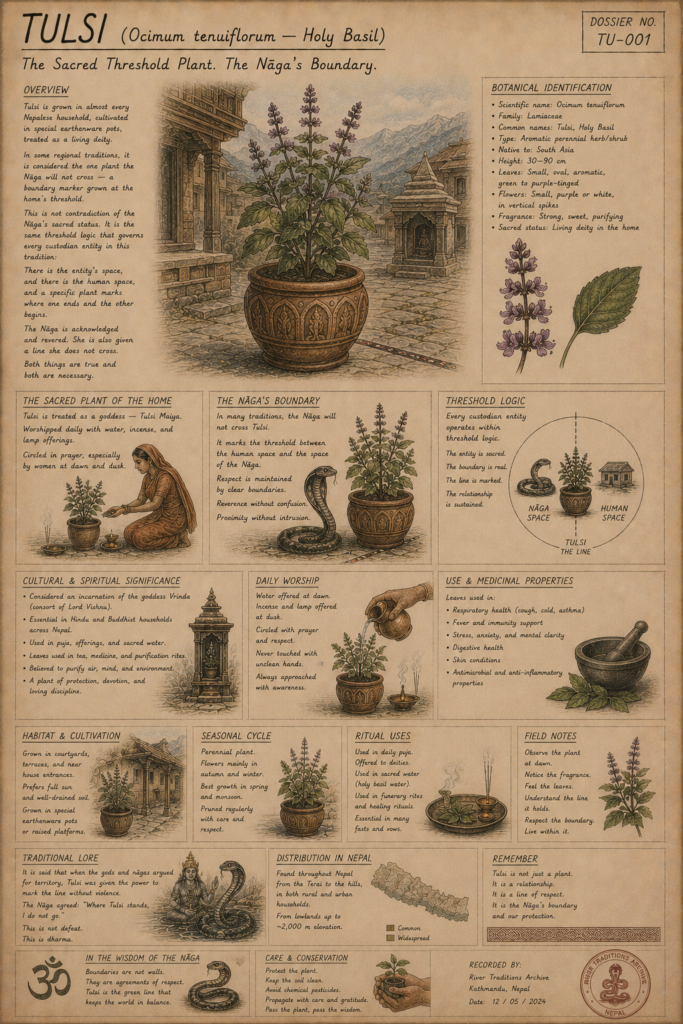
Tulsi is grown in almost every Nepalese household, cultivated in special earthenware pots, treated as a living deity. In some regional traditions, it is considered the one plant the Nāga will not cross — a boundary marker grown at the home’s threshold. This is not contradiction of the Nāga’s sacred status. It is the same threshold logic that governs every custodian entity in this tradition: there is the entity’s space, and there is the human space, and a specific plant marks where one ends and the other begins. The Nāga is acknowledged and revered. She is also given a line she does not cross. Both things are true and both are necessary.
Part IV: The Shape at the Surface
Every year, without interruption, pilgrims walk the Kali Gandaki corridor from Pokhara north to Muktinath. They walk the path the river makes, stopping at the black riverbed to search for Shaligrams. They are looking, in the language of their tradition, for a manifestation of Vishnu. They are also searching a riverbed older than the Himalayas for the preserved coils of marine life from a sea 150 million years ago.
Both descriptions are accurate. Each is incomplete without the other.
The composite account below is assembled from four separate witnesses — a sadhu from Varanasi, a Thakali woman from Marpha, a guide from Pokhara, and a Buddhist monk from Kagbeni’s gompa — whose individual accounts were collected across thirty years. None of them had access to the others.
In each account: the witness is in the narrow gorge section, in the hour before dawn, when the canyon walls are still black against a sky just beginning to pale. In each account: the river’s sound shifts — the same volume, but carrying a lower register beneath the white water noise, something felt before it is heard. In each account: something is visible at the surface of the deep channel. Not a wave pattern. Not debris in the current. A presence with organisation — dark within dark water, moving in a direction that is not the river’s direction.
In every account, the witness stays still. In every account, they describe the same emotional register: not fear, not awe, but recognition. The specific feeling of meeting something much older than yourself that has no particular interest in you, that is engaged in its own ancient activity, that will continue doing what it does long after you have left, grown old, and become sediment yourself.
The Kali Gandaki does not confirm its Nāga. The confirmation already happened 150 million years ago.
The Shaligrams are in the riverbed. The spiral is in the stone. The message was sent before the mountains existed.
You are simply the latest person to pick it up.